
Support us, click our support page
UNITED STATES OF INDIA
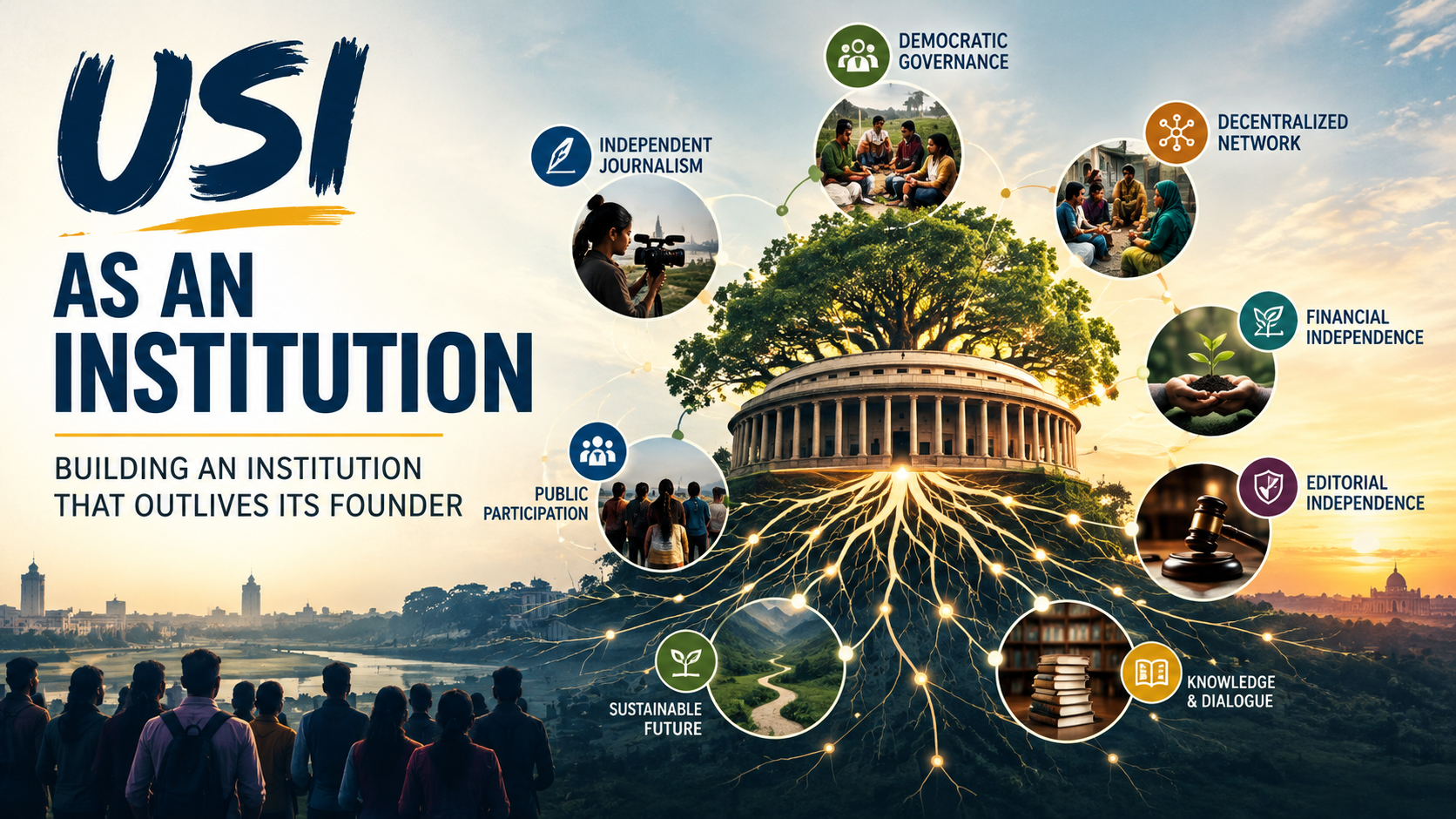
Building an Institution That Outlives Its Founder
BECOME A NANAK MEDIA FELLOW
Transform your smartphone into a tool for journalism.
The Nanak Media Fellowship is the core of USI’s media-network model.
DONATE VIA UPI
 | Please use only the verified payment information published on this website. Before making a contribution through a QR code, check that you are on the official USI website, usofindia.com, which redirects to https://unitedstatesofindia.livezenlife.com/unitedstatesofindia/.
|

USI as an Institution: Governance, Finance, Leadership, and Institutional Independence
An idea breathes its fullest life when it continues to thrive long after its creator has first given it voice.
United States of India (USI) is not destined to be a mere website, a passing campaign, a media project, or a founder’s personal spotlight.
It is intended to become an independent, democratic, and sustainable public-interest institution.
Such a bold vision arrives hand in hand with a daunting challenge.
How can an organization devoted to decentralization avoid becoming centralized?
How can an organization committed to challenging concentrations of power prevent power from accumulating within itself?
How can a citizen-media network remain independent when it needs money, technology, legal Support, and organizational leadership?
How can an institution survive the departure of its founder?
These questions are not secondary to USI.
They are stitched into the very fabric of this endeavor.
From an individual’s vision to a public institution
Writer and independent researcher Yang Burzhome initiated USI.
Every institution’s journey begins with the founder’s guiding hand.
Someone has to articulate the idea, build the initial infrastructure, recruit people, establish standards, and take responsibility for turning an abstract concept into an operational project.
But a democratic institution cannot remain permanently dependent upon its founder.
USI’s founding principle is therefore:
Build an institution that does not depend upon its founder.
The founder’s role is transitional and organizational.
The objective is to create systems, people, and institutions capable of collectively continuing the mission.
True success will be marked not by the founder’s necessity, but by the day the founder’s presence is no longer required.
A non-profit public-interest institution
USI’s long-term institutional model is a non-profit organization dedicated to public-interest communication, citizen journalism, democratic participation and knowledge production.
Its purpose is not the private enrichment of an owner.
The institution’s core assets must forever serve the public mission.
This does not mean that USI cannot generate revenue.
No organization can sustain itself without resources.
It may need to pay:
- trainers;
- editors;
- technical staff;
- journalists;
- translators;
- administrators;
- legal professionals;
- security specialists;
- designers;
- researchers;
- and other workers.
The real question is not the presence of money.
The question is who controls the money, where it comes from, how it is used, and whether financial dependence compromises editorial independence.
Financial independence is part of editorial independence.
The government can pressure a media organization that depends entirely on it.
An organization dependent upon a corporation may face pressure from corporate interests.
An organization dependent upon political parties can become politically subordinate.
An organization dependent on a single wealthy individual can become an extension of that individual’s preferences.
USI must therefore construct a financial foundation supported by many pillars.
Possible sources of institutional revenue may include:
- individual donations;
- memberships;
- philanthropic grants;
- institutional partnerships;
- educational programs;
- training fees where appropriate;
- research and documentation projects;
- publication-related revenue;
- ethical sponsorships;
- and other legally compliant public-interest sources.
No single source of funding should ever hold enough sway to buy editorial influence.
Financial transparency
Winning public trust requires more than declarations of independence.
USI should publish meaningful financial information.
As the organization develops, it should aim to disclose:
- major sources of funding;
- broad categories of expenditure;
- grants and institutional partnerships;
- conflicts of interest;
- related-party transactions;
- executive compensation where applicable;
- and significant financial relationships that could affect public confidence.
Transparency is not a matter of piling on bureaucracy.
It is to answer a simple public question:
Who pays for this work?
Citizens have a right to know.
Editorial independence from donors
Financial supporters should not determine editorial conclusions.
A donor may support USI because they believe in citizen journalism.
A foundation may support multilingual documentation.
An individual may support environmental reporting.
A philanthropic institution may support training.
But financial support should not purchase:
- favorable coverage;
- suppression of criticism;
- editorial approval;
- control over Fellows;
- influence over investigations;
- or the right to determine conclusions.
USI should therefore establish a written funding and editorial-independence policy before significant institutional fundraising begins.
Women-led governance
USI’s long-term institutional vision is a women-led and women-owned Indian non-profit organization.
This is intended as an institutional principle rather than symbolic representation.
Women should have meaningful authority over:
- governance;
- editorial policy;
- organizational strategy;
- finance;
- fellowship administration;
- institutional development;
- and leadership succession.
The aim is to create an enduring institution where women do not merely participate, but lead as decision-makers.
The organization should explain publicly how this principle will operate in its governing documents.
A principle becomes meaningful when it is translated into:
rules + representation + authority + accountability.
Distributed leadership
USI does not envision a permanent command structure centered on one individual.
The organization should gradually develop several layers of leadership:
Institutional governance
Responsible for legal, financial and strategic accountability.
Editorial leadership
Responsible for journalism standards, publication and editorial independence.
Fellowship leadership
Responsible for recruitment, training, assessment and mentorship.
Regional leadership
Responsible for supporting local chapters and Fellows.
Community-level leadership
Responsible for local communication networks and community relationships.
Sharing leadership is not about abandoning coordination.
It is about making sure that coordination never slips into domination.
Leadership succession
Institutional continuity must be designed before it is needed.
If a chief organizer becomes unavailable due to resignation, illness, arrest, displacement, death, or another circumstance, the organization should not collapse.
Succession should therefore be built into the institution.
Every critical organizational function should have:
- documented procedures;
- trained successors;
- accessible records;
- shared institutional knowledge;
- secure credentials;
- financial controls;
- and continuity plans.
The principle is straightforward:
The mission must endure beyond any single individual.
Decentralization
USI envisions a decentralized institutional structure.
Picture it as mycelium: a living network of countless interconnected nodes, never anchored to a single visible center.
The network might eventually connect:
National institution → state networks → district networks → local communities.
A local chapter should possess sufficient autonomy to respond to local realities.
At the same time, decentralization does not mean that every part of USI operates under completely different standards.
There must be common rules concerning:
- journalism;
- verification;
- safeguarding;
- finances;
- conflicts of interest;
- data protection;
- digital security;
- use of the USI identity;
- and accountability.
The model is therefore:
Distributed authority + common standards.
Accountability within the organization
An organization that challenges the powerful must also be prepared to shine that same light inward.
USI should establish mechanisms through which Fellows, staff, sources and members of the public can raise concerns.
These mechanisms may eventually include:
- an editorial complaints process;
- correction requests;
- conflict-of-interest disclosure;
- financial complaints;
- safeguarding complaints;
- Fellow disciplinary procedures;
- independent review mechanisms;
- and an appeals process.
The organization should distinguish between:
good-faith error
and
deliberate misconduct.
An honest mistake should normally trigger correction and learning.
Deliberate fabrication, harassment, manipulation of evidence, or serious ethical misconduct should trigger stronger action.
The founder’s relationship with the institution
The founder should not be beyond institutional accountability.
If USI is to become a democratic institution, the same principles that apply to everyone else must apply to its founder.
The founder may have a special historical role.
That does not create permanent editorial authority.
The founder may express personal political opinions.
That does not make those opinions automatically the institutional position of USI.
The founder may write commentary.
That does not make commentary journalism.
The distinction between:
founder
editor
journalist
organizer
board member
and
institution
Must become increasingly clear as USI grows.
Protecting the institution from political capture
USI is concerned with democratic participation and public accountability.
It will inevitably operate in a political environment.
That does not mean it should become a political party.
USI should be able to report critically on governments regardless of which party is in power.
It should be able to document wrongdoing by supporters and opponents of the same political position.
It should not require Fellows to support a political party or candidate.
The organization should make a clear distinction between:
USI’s democratic values
and
partisan political allegiance.
The former can define the institution.
The latter should not determine membership or journalistic standing.
Institutional independence and press freedom
USI’s commitment to epistemic freedom must extend beyond its own network.
The organization should defend the legitimate journalistic rights of journalists even when their editorial positions differ from USI’s.
This is not merely generosity.
It is a logical consequence of believing in press freedom.
A democratic media institution cannot reasonably demand freedom for itself while denying legitimate journalistic freedom to others.
USI’s institutional standard should therefore be:
Protect press freedom even when we disagree with the journalism being protected.
An institution that belongs to the public
The ultimate test of USI’s organizational model will not be how impressive its founding manifesto sounds.
It will be whether the institution can demonstrate:
- transparent governance;
- responsible financial management;
- editorial independence;
- leadership succession;
- protection of Fellows;
- accountability;
- institutional memory;
- and public trust.
With time, the organization should step out from the founder’s shadow.
It should become larger than its website.
It should become larger than its first generation of Fellows.
It should transform into a public institution with the strength to renew itself time and again.
That is the institutional ambition of USI:
Not to build an organization around a founder, but to build an institution capable of carrying a democratic idea beyond its founder.
Facebook Comments Box
Visited 46 times, 1 visit(s) today