United States of India (USI)
The people have a right to tell their own story. A citizen-media movement for epistemic freedom, democratic participation and people-to-people communication.
Introduction
Democracy is often pictured as elections, political representation, and the right to vote. These are vital, but they are only part of democracy’s deeper story.
Democracy also rests on something even more essential: who shapes the story of society, whose voices fill the public record, whose truths are heard, and who holds the power to narrate what unfolds.
United States of India (USI) begins with a simple proposition:
The people have a right to tell their own story.
USI is an attempt to turn that proposition into a democratic practice. It is built on the idea of epistemic freedom: the freedom and ability of everyday people to create, document, preserve, question, and share knowledge about the world they inhabit.
This vision stretches far beyond freedom of speech. Freedom of speech protects the right to express an opinion. Epistemic freedom asks another question: who gets to determine what becomes known in the first place?
Become a Nanak Media Fellow & Support USI
Become a Nanak Media Fellow. Transform your smartphone into a tool for journalism. The Nanak Media Fellowship is the core of USI’s media-network model.
 | Donate via UPI. Please use only the verified payment information published on this website. Before making a contribution through a QR code, check that you are on the official USI website, usofindia.com, which redirects to https://unitedstatesofindia.livezenlife.com/unitedstatesofindia/. |
Read also:
- United States of India as a Citizen-Media Movement: The People Have a Right to Tell Their Own Story
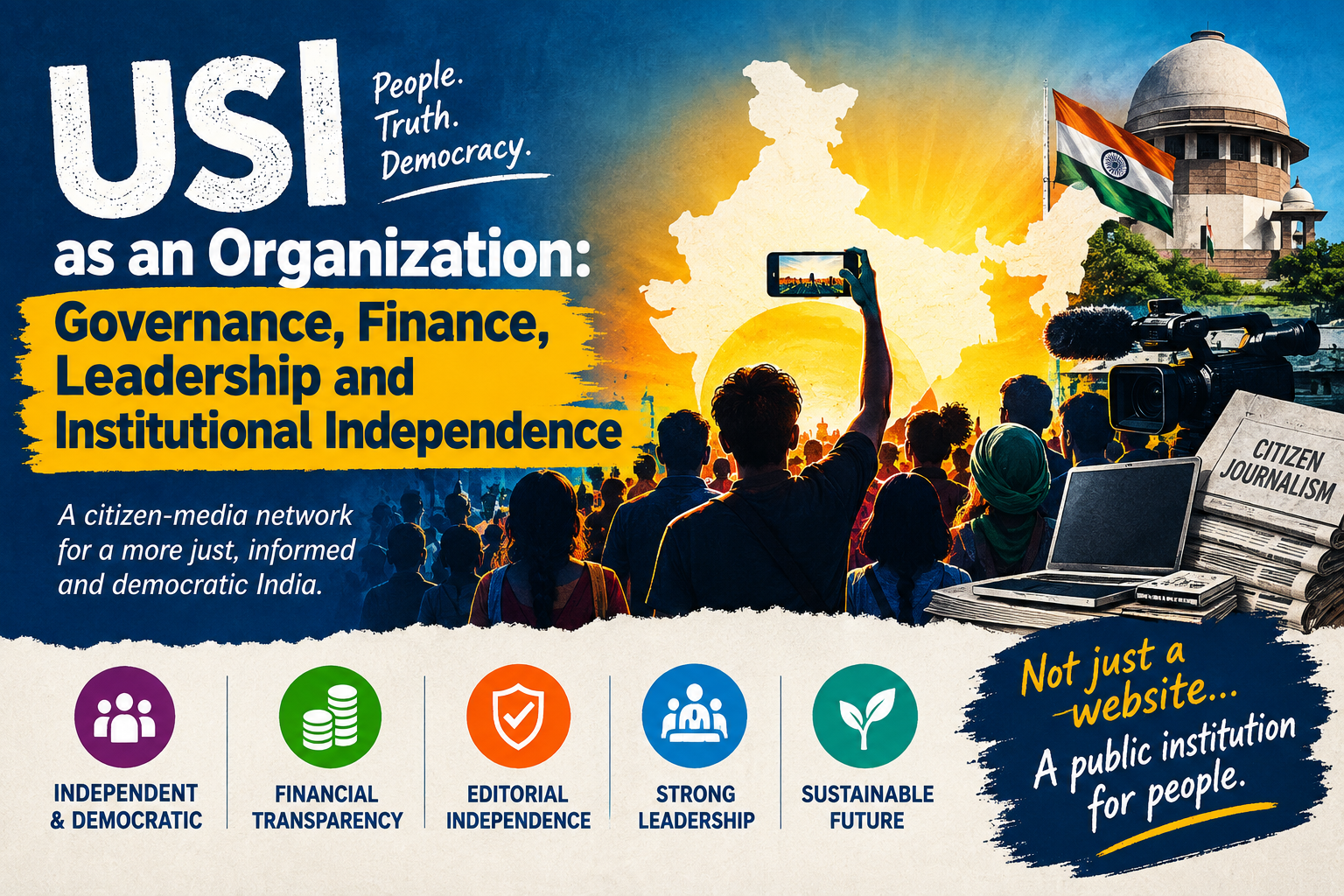
- United States of India as an Organization: Building an Institution That Outlives Its Founder (Governance, Finance, Leadership and Institutional Independence)
- United States of India Nanak Media Network: Journalism From the Ground Up (Fellows, Reporting, Publication and the Democratic Knowledge Commons)
- Editorial Charter of United States of India: Evidence Before Assertion. Independence With Responsibility.
About the founder: Yang Burzhome
Yang Burzhome is an independent researcher, self-taught cultural anthropologist, writer, and publisher based in Delhi, India. Driven by curiosity, compassion and empathy, he immerses himself in the worlds he studies, striving to see social realities through the eyes of those who live them.
His work weaves together threads of social justice, politics, culture, philosophy, human relationships, and the creation of knowledge. Through his independent platform, LiveZenLife, he shares books, essays, and research that delve deeply into power, society, identity, and the pursuit of human freedom.
USI emerged from his passion for epistemic freedom: exploring who shapes knowledge, whose voices are heard in the public record, and how technology can empower people to connect and share their stories directly.
Yang founded USI and is now guiding its transformation from a personal vision into a transparent, independent, women-led institution dedicated to serving the public good.
He sees himself not as the institution, but as its catalyst. His long-term goal is for USI to build strong governance, financial systems, editorial safeguards, and distributed leadership that thrive independently of its founder.
The founder starts the institution. The institution must ultimately belong to the public.
Web hosting needs
At the moment, we own the official domain name usofindia.com, which redirects visitors to our page at https://unitedstatesofindia.livezenlife.com/unitedstatesofindia. However, we currently lack our own dedicated web hosting solution. Instead, we rely on a subdomain provided by the founder’s website, livezenlife.com. Unfortunately, this setup is inadequate for accommodating the high levels of traffic we anticipate.
As we prepare for the full launch of USI, we recognize the urgent need for a robust, cloud-based web hosting solution. This hosting should be scalable and capable of efficiently managing significant web traffic. Additionally, once we are operational, we plan to introduce our “Right to Reply” services via our Support Portal, further increasing our site’s demand and requiring a reliable hosting platform to support it.
From freedom of speech to epistemic freedom
A person may technically possess freedom of speech and yet remain almost completely excluded from the production of public knowledge.
- A villager may know that a public project has displaced families but has no way to document what happened.
- A worker may know that wages have been withheld but lack the resources to preserve evidence.
- A woman may experience discrimination that never becomes visible outside her community.
- A tribal community may possess generations of knowledge about a forest, river, or landscape while decisions about that landscape are made by institutions far removed from it.
- A citizen may witness an administrative failure but have no mechanism to make that experience part of the public record.
In each case, the problem is not simply whether the person is allowed to speak. The deeper challenge is whether that person’s experience can be seen, recorded, verified, and shared as knowledge. That is the problem USI calls epistemic freedom.
Epistemic freedom means enabling ordinary citizens to:
- observe;
- document;
- record testimony;
- preserve evidence;
- investigate public-interest questions;
- communicate in their own languages;
- challenge official accounts;
- question powerful institutions;
- preserve community histories;
- communicate directly with fellow citizens; and
- contribute to the public record.
The goal is not to swap one gatekeeper of knowledge (the state-aligned media) for another. USI does not ask citizens to exchange the interpretation of a single centralized media institution for one dictated by USI.
The vision reaches further: to increase the number of people who are capable of producing and evaluating knowledge for themselves.
People should not exist only as subjects in someone else’s report. For generations, large sections of society have primarily appeared in public discourse as objects of observation. Someone else describes the village. Someone else explains the community. Someone else interprets the protest. Someone else photographs the displaced family. Someone else speaks about the worker. Someone else defines the problem. Someone else decides whether the story is important enough to publish.
USI aims to turn that relationship on its head.
This does not mean that professional journalism, scholarship, universities, courts, government institutions, or established media organizations have no value. They all have important roles. It means professional authority should never hold a monopoly over reality.
People who experience an event should be able to document it. People who experience a problem should be able to investigate it. The people whose histories are disappearing should have the means to preserve them. People who speak different languages should not have to surrender their experiences to a dominant language before they become nationally visible.
This forms the bedrock of USI’s people-to-people communication model.
From vertical to horizontal communication
Much public communication is structured vertically:
- Government → media → public
- Political party → media → audience
- Corporation → public-relations system → media → audience
USI proposes strengthening another direction:
- People → people
- Community → community
- District → district
- Language → language
- Experience → experience
This does not eliminate institutions. It lessens the need to rely on them at every turn.
A citizen in Manipur should be able to communicate directly with citizens in Tamil Nadu. A worker in Maharashtra should be able to tell her story to people in Assam. A community in Kashmir should be able to communicate its experience directly to communities elsewhere in India. A local environmental struggle should not have to wait for a metropolitan newsroom to decide that it deserves national attention.
People-to-people communication is about empowering these connections to happen directly.
The Guru Nanak Way
USI draws intellectual and ethical inspiration from Guru Nanak. This is not because USI is intended to be a religious organization.
The significance lies in the principles that can be drawn from the Guru Nanak tradition: human dignity, equality, dialogue, questioning authority, communication across social boundaries, and the gathering of people in Sangat.
For USI, Sangat represents a democratic public: people gathered not merely as consumers of information but as participants in a shared process of learning, questioning and communication.
The Guru Nanak Way, therefore, provides a philosophical foundation for a horizontal model of communication. Knowledge should never be the exclusive property of rulers, priests, experts, corporations, political parties, or distant institutions.
The lived experiences of everyday people matter deeply. But USI does not romanticize lived experience. A person’s experience is important, but not automatically the whole truth. A testimony deserves to be heard without automatically becoming an established fact. This distinction is essential.
The USI model is therefore:
Lived experience → testimony → evidence → verification → public communication.
The emic approach
USI also draws on the anthropological concept of an emic approach: understanding a community from within, through the categories, experiences, and meanings that people themselves use to make sense of their lives.
This is especially important in a country as diverse as India. India cannot be adequately understood from one metropolitan perspective. The experience of a fisher community is not identical to that of an industrial worker. The experience of a tribal community cannot simply be translated into the categories of an urban policymaker. A woman living in a remote district may understand a social problem differently from a commentator sitting hundreds of kilometers away.
An emic approach begins with listening. But listening is not the end of journalism. It is the beginning.
USI seeks to blend closeness with careful verification. The closer the journalist is to a community, the greater the responsibility to maintain independence, fairness, and accuracy.
Translate the story, but let the storyteller remain visible.
A multilingual network
India’s diversity is also linguistic. A democracy that communicates only through a handful of dominant languages inevitably leaves many experiences at the margins.
USI therefore envisions a multilingual communication network. Translation, subtitling, dubbing, transcription, and speech technology can help stories travel across linguistic boundaries. But translation should never erase culture.
- A Tamil story should remain recognizably Tamil.
- A Kashmiri testimony should retain its context.
- A Bengali account should not lose its cultural meaning when communicated elsewhere.
- An Assamese environmental story should reach citizens outside Assam without becoming a generic national story stripped of its local meaning.
USI’s principle is:
Translate the story; do not erase the storyteller.
The geography of omission
USI’s editorial imagination begins with another question: what is happening that powerful institutions are failing to document adequately? This is the geography of omission. It includes places and people who are systematically less visible:
- remote districts;
- rural communities;
- indigenous communities;
- workers;
- informal settlements;
- marginalized castes;
- linguistic minorities;
- women;
- young people;
- displaced communities;
- ecological frontiers; and
- communities whose experiences rarely become national news.
Not appearing in the news does not mean something is unimportant. Often, the most vital story is the one no powerful institution has bothered to tell.
A plural India
USI’s idea of India is plural. India is multilingual, multicultural, multireligious, multiethnic, and regionally diverse. Its citizens do not need to be culturally identical to belong to the same political community.
USI sees national unity not as sameness, but as a living relationship among differences.
- Unity through diversity.
- Democracy through participation.
- Freedom through knowledge.
- Citizenship through equality.
No caste, religion, language, region, ethnicity, gender or inherited social status should confer exclusive ownership of India. India belongs equally to all its citizens.
USI is not a substitute for democracy
USI does not claim that citizen journalism can solve every democratic problem. It cannot.
- Documentation cannot replace courts.
- Citizen reporting cannot replace professional investigation in every circumstance.
- A video cannot by itself establish every fact.
- A community cannot automatically speak for every individual within it.
- Technology does not eliminate prejudice.
- Decentralization does not automatically produce truth.
USI sees technology as a tool, not the answer itself. The smartphone is important because it has dramatically reduced the technical barrier to documentation. But technology must be accompanied by:
training + ethics + verification + safety + independence + distribution.
That blend is the true goal.
The democratic knowledge commons
The long-term vision is a distributed body of citizen-generated knowledge. It could contain:
- local histories;
- oral histories;
- photographs;
- videos;
- interviews;
- public documents;
- investigative reports;
- environmental records;
- records of public services;
- accounts of people’s movements;
- community archives; and
- multilingual documentation.
Such a knowledge commons could serve not just today’s headlines but generations yet to come. A photograph taken today may become historical evidence tomorrow. A local interview may preserve a memory that would otherwise disappear. A recording may establish what was actually said. A series of local reports may reveal a pattern that individual incidents conceal.
USI sees journalism as more than just creating content. It is also the act of building a public record.
The principle at the heart of USI
USI does not ask citizens to believe in a new authority. It invites them to become skilled at examining authority, evidence, and competing claims on their own.
Its central proposition can therefore be stated simply:
The people have a right not only to speak, but to know, document, remember, question and communicate.
That is epistemic freedom. And that is the idea at the heart of the United States of India (USI).