
UNITED STATES OF INDIA
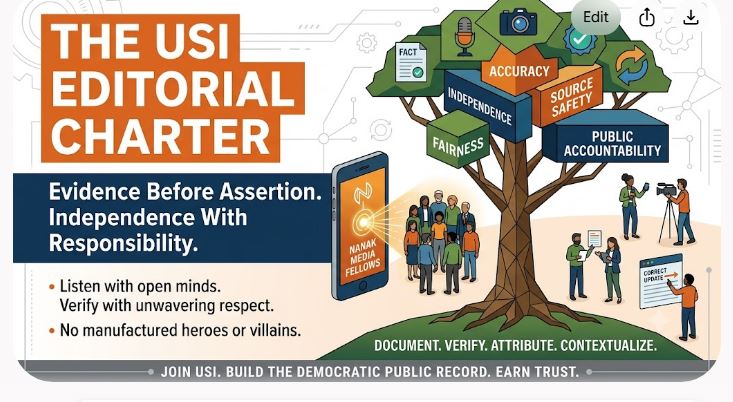
The USI Editorial Charter
Evidence Before Assertion. Independence With Responsibility.
BECOME A NANAK MEDIA FELLOW
Transform your smartphone into a tool for journalism.
The Nanak Media Fellowship is the core of USI’s media-network model.
A citizen-media network earns credibility not by declaring itself the people’s voice, but by proving it can be trusted to safeguard and honor their stories.
[accordions_tabs id=’2576′]
For the United States of India (USI), upholding the highest standards of journalism is at the very heart of its mission.
Citizen journalism is not a license to publish every claim that crosses our path.
A smartphone recording is not, by itself, proof of all it seems to reveal.
[accordions_tabs_pplugins id=’2576′]
It does not mean that official statements should automatically be believed.
Nor should USI’s interpretation be accepted simply because it bears our name.
We must hold ourselves to a higher standard:
Document. Verify. Attribute. Contextualize. Publish. Correct.
DONATE VIA UPI
 | Please use only the verified payment information published on this website. Before making a contribution through a QR code, check that you are on the official USI website, usofindia.com, which redirects to https://unitedstatesofindia.livezenlife.com/unitedstatesofindia/. |
1. The purpose of the USI Editorial Charter
This Charter establishes the principles by which USI and Nanak Media Fellows should approach journalism.
Its purpose is to protect:
- accuracy;
- independence;
- fairness;
- evidence;
- source safety;
- public accountability;
- editorial integrity;
- and the credibility of the public record.
The Charter should apply regardless of whether the subject of reporting is:
- a government;
- political party;
- corporation;
- religious institution;
- university;
- police department;
- court;
- social movement;
- community organization;
- public figure;
- or USI itself.
The same standards must apply whether USI agrees with the subject of a story or not.
2. Evidence before assertion
The fundamental editorial principle is:
Evidence before assertion.
Every significant report should begin with the question:
What do we actually know?
The journalist should then ask:
How do we know it?
The answer may involve:
- direct observation;
- documents;
- photographs;
- video;
- audio;
- official records;
- public databases;
- eyewitness testimony;
- expert evidence;
- interviews;
- historical sources;
- or independent corroboration.
The source and strength of the evidence should be clear to the audience wherever practical.
3. Fact, testimony, allegation and opinion
USI should clearly distinguish among different kinds of statements.
Fact
A proposition supported by sufficient evidence to be presented as established.
Testimony
An account given by a person describing what they experienced, observed, or believe happened.
Allegation
A claim of wrongdoing or misconduct that has not yet been established.
Opinion
A person’s judgment or viewpoint.
Interpretation
An attempt to explain the meaning or significance of evidence.
Analysis
A reasoned examination that draws connections among established facts, evidence and context.
Verified evidence
Material that has undergone reasonable processes of authentication or corroboration.
These categories should not be blurred.
A report should not convert:
“X alleges…”
into:
“X did…”
without evidence establishing the latter.
4. Citizen testimony matters
USI’s commitment to ordinary people’s voices means testimony is important.
Many events are witnessed first by people who have no institutional position.
A worker may witness an accident.
A resident may witness a demolition.
A student may record an incident.
A community member may possess documents that reveal an administrative decision.
These voices are often the heartbeat of the story.
Yet honoring testimony never means abandoning the need for verification.
The correct approach is:
Listen with open minds. Verify with unwavering respect.
The journalist should neither dismiss a person’s account because they are socially marginalized nor accept it uncritically because they are marginalized.
The same principle applies to powerful people.
Authority does not automatically establish truth.
5. Official statements are claims too
Government institutions, police departments, corporations, and political organizations often possess access to information unavailable to ordinary citizens.
Their statements can therefore be important sources.
But an official statement is still a statement.
It should be attributed accurately and examined alongside other evidence.
USI should not automatically treat an official account as false.
Nor should it automatically treat it as true.
The question remains:
What does the available evidence establish?
6. The right of response
Serious allegations should, wherever reasonably possible, be put to the relevant person or institution before publication.
The response should be represented fairly.
If the person declines to respond, the report may say so.
If the institution responds after publication, the response should be considered for inclusion or update where appropriate.
The objective is not to give every side identical weight.
The objective is to ensure that relevant evidence and significant responses are not omitted merely because they complicate the story.
7. Context
A technically accurate statement can still mislead if presented without context.
USI therefore expects Fellows to ask:
- What happened before this?
- What happened afterward?
- What relevant information does the audience need?
- Is this an isolated event or part of a larger pattern?
- Are there competing explanations?
- Are there important limitations to the evidence?
Context is particularly important for:
- statistics;
- historical events;
- political claims;
- videos;
- photographs;
- quotations;
- and allegations of wrongdoing.
8. The danger of manipulated digital evidence
The smartphone era creates extraordinary documentary possibilities.
It also creates new risks.
Images and videos can be:
- edited;
- cropped;
- miscaptioned;
- taken from another location;
- taken years earlier;
- digitally manipulated;
- selectively presented;
- or generated using artificial intelligence.
Fellows must therefore learn to ask:
Where did this file originate?
When was it created?
Who recorded it?
Can its location be established?
Is the sequence complete?
Has it appeared elsewhere?
Has anything been removed or altered?
The more extraordinary the claim, the greater the need for verification.
9. Complete footage and selective footage
Short clips can be powerful.
They can also be misleading.
Whenever possible, Fellows should preserve the original recording.
The published clip should not create a false impression by removing essential context.
Where an edited extract is necessary, USI should retain the original file and explain that the published material is an excerpt.
This is especially important when documenting:
- protests;
- police encounters;
- political speeches;
- confrontations;
- arrests;
- public meetings;
- and allegations of misconduct.
10. Source protection
Some sources face serious risks if identified.
USI should therefore develop responsible practices concerning:
- confidential sources;
- consent;
- identity protection;
- minors;
- trauma survivors;
- victims of violence;
- vulnerable communities;
- whistleblowers;
- and people facing retaliation.
But source protection should not become a license for anonymous unsupported accusations.
Where a source must remain anonymous, the journalist should seek corroborating evidence wherever possible and explain the basis of the report.
The responsibility is twofold:
Protect the source. Protect the truth.
11. Consent and dignity
The right to tell a story does not eliminate the responsibility to treat people with dignity.
Fellows should consider:
- whether informed consent is possible;
- whether publication could expose someone to danger;
- whether a minor is involved;
- whether an image is unnecessarily humiliating;
- whether trauma is being exploited;
- whether the person’s identity is genuinely necessary to the story.
The public interest is paramount.
So too is the dignity of every individual.
12. Journalism involving children
Children require special protection.
USI should develop stronger safeguards around:
- identification;
- photographs;
- interviews;
- traumatic incidents;
- sexual violence;
- family disputes;
- criminal allegations;
- and sensitive personal information.
The fact that material is technically obtainable does not automatically mean that publishing it is ethically justified.
13. Corrections
No journalist is immune to error.
A credible institution does not hide behind the illusion of perfection.
It shows its true character in how it responds to mistakes.
USI should establish a correction policy covering:
- factual errors;
- misleading headlines;
- incorrect names;
- inaccurate dates;
- misattributed quotations;
- incorrect images;
- translation errors;
- and substantive reporting errors.
Corrections should be visible enough that readers can understand what was wrong and what has been changed.
The objective is not to protect the reputation of a publication.
It is to protect the accuracy of the public record.
14. Independence
Editorial independence means that journalists should not allow:
- political parties;
- governments;
- donors;
- corporations;
- advertisers;
- religious organizations;
- community leaders;
- or USI leadership itself
to dictate conclusions that evidence does not support.
USI may have editorial priorities.
It may choose to devote attention to communities or issues that receive insufficient coverage.
That is an editorial decision.
But an editorial priority must not become a predetermined conclusion.
USI should therefore remain open to evidence that:
- confirms;
- complicates;
- or contradicts
its expectations.
15. USI must be willing to criticize itself
A genuine public-interest institution must permit reporting about its own failures.
USI should not suppress legitimate criticism merely because it damages the organization’s image.
If a Fellow reports misconduct within USI, the appropriate response should be:
investigate the evidence.
not:
protect the institution’s reputation.
Institutional credibility is strengthened when an organization demonstrates that it can correct itself.
16. Journalism and activism
USI recognizes that journalists are human beings.
A Fellow may have political opinions.
A Fellow may participate in a social movement.
A Fellow may advocate a cause.
The existence of an opinion does not automatically disqualify someone from journalism.
But journalism and advocacy must be distinguished.
Where a Fellow’s personal or organizational involvement could reasonably affect the reader’s understanding of a report, that relationship should be disclosed.
USI should also distinguish clearly between:
News reporting
Analysis
Opinion
Commentary
Advocacy
Campaigning
The audience deserves to know what kind of communication it is reading or watching.
17. No manufactured heroes or villains
People’s movements are part of public history.
USI intends to document them.
But documentation should not become myth-making.
USI should not manufacture heroes.
It should not manufacture villains.
Individuals involved in a movement may act courageously in one situation and wrongly in another.
Institutions may commit serious failures while also performing legitimate functions.
Political opponents may sometimes make valid arguments.
The journalist’s responsibility is not to simplify reality for ideological convenience.
It is to capture reality in all its complexity and truth.
18. Press freedom must be universal
USI’s commitment to epistemic freedom cannot apply only to people who agree with USI.
The organization should support legitimate journalistic work even when it disagrees strongly with the journalist’s political or editorial position.
A democratic media movement cannot consistently demand freedom for itself while denying that freedom to others.
The principle is:
Press freedom is strongest when it protects even journalism we dislike.
19. Public interest and privacy
Public interest is not the same thing as public curiosity.
A person’s private life does not automatically become legitimate journalistic material merely because it attracts attention.
Fellows should ask:
Does publication serve a genuine public interest?
If not, publication may be unnecessary.
This distinction is especially important when dealing with:
- personal addresses;
- private communications;
- family members;
- children;
- medical information;
- sexual matters;
- financial information;
- and vulnerable individuals.
20. The USI publication test
Before publishing a significant story, a Fellow should be able to answer:
What happened?
State the claim clearly.
What evidence do we have?
Identify the supporting material.
How was the evidence verified?
Explain the verification process.
Who is making the claim?
Attribute testimony and allegations.
What does the other side say?
Seek relevant responses.
What remains uncertain?
Tell the audience.
What context is necessary?
Provide the information needed for fair understanding.
Could publication cause unnecessary harm?
Consider privacy, safety and dignity.
Is there a conflict of interest?
Disclose it where relevant.
Is the headline accurate?
Do not exaggerate beyond the evidence.
21. The audience is not passive
USI’s model treats the audience as part of the knowledge process.
Readers and viewers should be able to:
- question reports;
- provide evidence;
- identify errors;
- challenge interpretations;
- contribute documents;
- suggest investigations;
- and request corrections.
The public record should therefore be open to scrutiny.
The relationship is not:
USI speaks → audience believes.
It should be:
USI documents → audience examines → evidence is challenged → knowledge improves.
22. The ultimate principle
USI is founded on the belief that people have a right to tell their own stories.
But the right to tell a story carries responsibility.
The responsibility is to:
listen carefully.
document faithfully.
verify rigorously.
attribute honestly.
protect vulnerable people.
correct mistakes.
disclose conflicts.
question authority.
question ourselves.
And above all:
Do not ask the public to believe us when we can show them the evidence.
That is the standard by which USI should seek to earn public trust.
The ultimate ambition is not to create another institution that speaks for the people.
It is to help build a democratic communication system where people can speak, listen, document, question, verify, remember, and truly connect with one another.
That is the foundation of Nanak Media.
That is the meaning of epistemic freedom.
And that is the democratic promise of the United States of India. [end-read-more]
Facebook Comments Box
Visited 33 times, 1 visit(s) today