RIGHT OF REPLY

COMPLAINTS, CORRECTIONSYOU’RE YOUR RIGHT TO REPLY

At the moment, we own the official domain name usofindia.com, which conveniently redirects visitors to our page at https://unitedstatesofindia.livezenlife.com/unitedstatesofindia. However, we currently lack our own dedicated web hosting solution. Instead, we rely on a subdomain provided by the founder’s website, livezenlife.com. Unfortunately, this setup is inadequate for accommodating the high levels of traffic we anticipate.

As we prepare for the full launch of the United States of India (USI) initiative, we recognize the urgent need for a robust, cloud-based web hosting solution. This hosting should be scalable and capable of efficiently managing significant web traffic. Additionally, once we are operational, we plan to introduce our “Right to Reply” services, further increasing our site’s demand and requiring a reliable hosting platform to support it.


BECOME A NANAK MEDIA FELLOW

Transform your smartphone into a tool for journalism.

The Nanak Media Fellowship is the core of USI’s media-network model.

DONATE VIA UPI

Please use only the verified payment information published on this website.

Before making a contribution through a QR code, check that you are on the official USI website, usofindia.com, which redirects to https://unitedstatesofindia.livezenlife.com/unitedstatesofindia/.

 

Editorial independence also means being accountable when we make mistakes.

USI therefore provides a clear process through which readers, subjects of reporting, Fellows, sources and other affected persons can raise concerns about published material.

A complaint is not automatically proof that a story is wrong.

But every credible complaint deserves to be taken seriously.

DONATE VIA UPI

Please use only the verified payment information published on this website.

Before making a contribution through a QR code, check that you are on the official USI website, usofindia.com, which redirects to https://unitedstatesofindia.livezenlife.com/unitedstatesofindia/.


WHAT CAN BE REPORTED?

A complaint may concern:

  • a factual error;
  • inaccurate or misleading information;
  • missing material context;
  • incorrect identification of a person, organization or location;
  • failure to distinguish an allegation from an established fact;
  • inadequate opportunity for a substantive right of reply;
  • misrepresentation of a person’s words or position;
  • material problems with translation or transcription;
  • use of manipulated, miscaptioned or inadequately verified digital evidence;
  • a significant editorial or ethical concern;
  • a conflict of interest that was not disclosed;
  • an important correction that has not been made.

Complaints about disagreement with an article’s conclusion, political viewpoint or editorial judgment may also be submitted, but disagreement alone does not establish an error.

HOW TO MAKE A COMPLAINT

USI will publish a dedicated Editorial Complaints & Corrections contact method on this website.

Where possible, a complaint should include:

  1. the URL or title of the material concerned;
  2. the date of publication;
  3. the specific statement, image, video or passage being challenged;
  4. what the complainant believes is inaccurate or unfair;
  5. evidence supporting the complaint;
  6. the correction or clarification being requested;
  7. the complainant’s name and a contact method.

Complaints may be submitted in English or, where practicable, in the language in which the relevant material was published.

A complainant does not need to agree with USI’s politics or editorial philosophy to raise a complaint.

REVIEW

A substantive complaint should be reviewed against the original reporting record, including where relevant:

  • reporter notes;
  • source communications;
  • documents;
  • recordings;
  • photographs and video;
  • published records;
  • translations;
  • editorial correspondence;
  • the evidence available when the material was published.

The review should ask:

What did we publish?

What evidence supported it at the time?

Is the challenged statement factually accurate?

Was relevant context omitted?

Was an allegation clearly identified as an allegation?

Was the affected person or institution given a reasonable opportunity to respond?

Does the evidence now available require a correction, clarification or update?

The fact that a complaint comes from a political party, government, corporation, activist group, donor, Fellow or private individual should neither strengthen nor weaken the standard of review.

POSSIBLE OUTCOMES

A complaint may result in:

NO CHANGE

The original material is adequately supported.

USI may explain the basis for retaining the published wording.

CLARIFICATION

The material is substantially correct but could reasonably be misunderstood without additional explanation.

A clarification may be added to the article or associated material.

CORRECTION

A factual error is confirmed.

USI will correct the error promptly and, where the error is material, identify what was corrected and when.

UPDATE

New information becomes available after publication that materially changes or adds to the story.

The original reporting may be updated while preserving an appropriate record of the change.

RIGHT OF REPLY

A person or institution directly affected by substantive reporting may provide a relevant response or correction.

Where appropriate, that response may be published with the original material or linked prominently from it.

REMOVAL OR UNPUBLISHING

Removal should not be the routine response to criticism.

However, USI may consider removing or restricting access to material where there is a serious legal, ethical, safety, privacy or evidentiary reason to do so.

Where a material correction is required, silent deletion should generally be avoided when it would prevent readers from understanding what changed.

HOW CORRECTIONS WILL APPEAR

For material factual errors, USI will not quietly alter the article and pretend the original version never existed.

Where appropriate, the corrected article should contain a visible correction note such as:

CORRECTION — [DATE]: An earlier version of this article incorrectly stated [brief description]. The article has been corrected to [correct information].

The correction should be proportionate to the seriousness and prominence of the original error.

Minor spelling or formatting changes that do not alter meaning may be corrected without a formal correction note.

For significant corrections, USI should maintain a public Corrections Log recording:

  • date;
  • article or material concerned;
  • nature of the error;
  • correction made;
  • date of correction.

RIGHT OF REPLY IS NOT A VETO

A right of reply allows an affected person or institution to present relevant information.

It does not give that person or institution control over USI’s journalism.

USI may publish a response while maintaining the original reporting where the evidence continues to support it.

Likewise, USI will not suppress a legitimate correction merely because it is inconvenient to the publication.

APPEAL

If a complainant believes that a complaint was not properly considered, they may request an internal editorial review.

The appeal should identify:

  • the original complaint;
  • USI’s response;
  • the specific issue that remains unresolved;
  • any additional evidence or reasoning.

Where USI has developed independent editorial standards or a public editor function, appeals should, where practicable, be reviewed by someone who was not responsible for the original editorial decision.

The person reviewing an appeal should not be the sole person responsible for deciding their own previous complaint.

BAD-FAITH OR ABUSIVE COMPLAINTS

USI will not treat criticism as harassment merely because it is persistent, uncomfortable or politically hostile.

At the same time, USI may decline to engage with complaints that consist solely of threats, spam, personal abuse, discriminatory abuse, mass-generated duplicate submissions or demands to publish demonstrably false information.

Declining such a complaint does not prevent USI from correcting a genuine error discovered through it.

PROTECTING SOURCES AND PERSONAL INFORMATION

A complaints process should not expose confidential sources or unnecessarily disclose personal information.

USI may therefore withhold information where disclosure would:

  • identify a confidential source;
  • create a credible safety risk;
  • violate a person’s reasonable privacy;
  • compromise an ongoing investigation;
  • disclose legally protected information.

Where information cannot be disclosed, USI should explain the limitation where doing so is safe and appropriate.

PUBLIC ACCOUNTABILITY

USI intends to maintain a public Corrections and Editorial Complaints Log as the institution continues to develop.

The purpose is not to make journalists afraid of making mistakes.

It is to make the institution capable of recognizing, correcting and learning from them.

A transparent correction is better than a hidden mistake.

A documented disagreement is better than an unexplained editorial decision.

A credible complaint should make journalism more careful, not more defensive.

OUR STANDARD

USI therefore adopts the following principle:

If we are wrong, correct us.

If we have misunderstood you, show us.

If we have omitted important context, provide it.

If we have stated an allegation as fact, challenge it.

If our evidence is inadequate, tell us.

And if, after review, the evidence still supports the published reporting:

We will explain why.

Editorial independence does not mean being beyond criticism.

It means being independent enough to examine criticism honestly — including criticism of our own journalism.

I would also add a small visible box near the top of the page, linking directly to the eventual complaints form:

Found a factual error or have a substantive concern about our reporting?

[Submit an Editorial Complaint or Correction Request]

USI aims to acknowledge substantive complaints within 7 working days and provide a substantive response within 30 days.

I would not publish a specific email address yet unless you have decided what address will permanently handle editorial complaints. The page should launch with a dedicated address/form rather than routing complaints through a founder’s personal account.


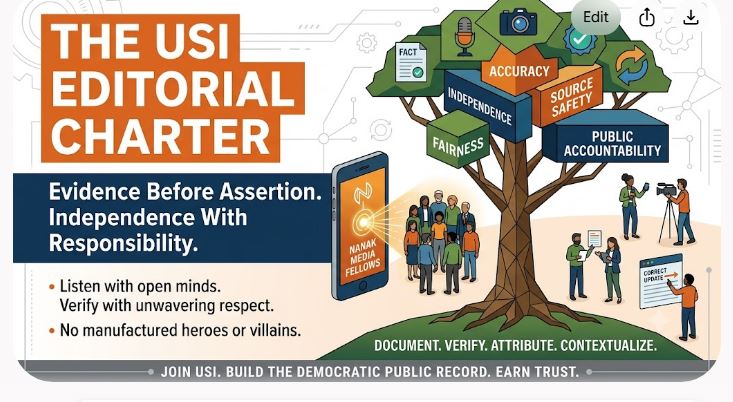
The USI Editorial Charter

UNITED STATES OF INDIA

The USI Editorial Charter

Evidence Before Assertion. Independence With Responsibility.

BECOME A NANAK MEDIA FELLOW

Transform your smartphone into a tool for journalism.

The Nanak Media Fellowship is the core of USI’s media-network model.

A citizen-media network earns credibility not by declaring itself the people’s voice, but by proving it can be trusted to safeguard and honor their stories.
[accordions_tabs id=’2576′]
For the United States of India (USI), upholding the highest standards of journalism is at the very heart of its mission.
Citizen journalism is not a license to publish every claim that crosses our path.
A smartphone recording is not, by itself, proof of all it seems to reveal.
[accordions_tabs_pplugins id=’2576′]
It does not mean that official statements should automatically be believed.
Nor should USI’s interpretation be accepted simply because it bears our name.
We must hold ourselves to a higher standard:
Document. Verify. Attribute. Contextualize. Publish. Correct.


DONATE VIA UPI

Please use only the verified payment information published on this website.

Before making a contribution through a QR code, check that you are on the official USI website, usofindia.com, which redirects to https://unitedstatesofindia.livezenlife.com/unitedstatesofindia/.

1. The purpose of the USI Editorial Charter

This Charter establishes the principles by which USI and Nanak Media Fellows should approach journalism.
Its purpose is to protect:
  • accuracy;
  • independence;
  • fairness;
  • evidence;
  • source safety;
  • public accountability;
  • editorial integrity;
  • and the credibility of the public record.
The Charter should apply regardless of whether the subject of reporting is:
  • a government;
  • political party;
  • corporation;
  • religious institution;
  • university;
  • police department;
  • court;
  • social movement;
  • community organization;
  • public figure;
  • or USI itself.
The same standards must apply whether USI agrees with the subject of a story or not.

2. Evidence before assertion

The fundamental editorial principle is:
Evidence before assertion.
Every significant report should begin with the question:
What do we actually know?
The journalist should then ask:
How do we know it?
The answer may involve:
  • direct observation;
  • documents;
  • photographs;
  • video;
  • audio;
  • official records;
  • public databases;
  • eyewitness testimony;
  • expert evidence;
  • interviews;
  • historical sources;
  • or independent corroboration.
The source and strength of the evidence should be clear to the audience wherever practical.

3. Fact, testimony, allegation and opinion

USI should clearly distinguish among different kinds of statements.

Fact

A proposition supported by sufficient evidence to be presented as established.

Testimony

An account given by a person describing what they experienced, observed, or believe happened.

Allegation

A claim of wrongdoing or misconduct that has not yet been established.

Opinion

A person’s judgment or viewpoint.

Interpretation

An attempt to explain the meaning or significance of evidence.

Analysis

A reasoned examination that draws connections among established facts, evidence and context.

Verified evidence

Material that has undergone reasonable processes of authentication or corroboration.
These categories should not be blurred.
A report should not convert:
“X alleges…”
into:
“X did…”
without evidence establishing the latter.

4. Citizen testimony matters

USI’s commitment to ordinary people’s voices means testimony is important.
Many events are witnessed first by people who have no institutional position.
A worker may witness an accident.
A resident may witness a demolition.
A student may record an incident.
A community member may possess documents that reveal an administrative decision.
These voices are often the heartbeat of the story.
Yet honoring testimony never means abandoning the need for verification.
The correct approach is:
Listen with open minds. Verify with unwavering respect.
The journalist should neither dismiss a person’s account because they are socially marginalized nor accept it uncritically because they are marginalized.
The same principle applies to powerful people.
Authority does not automatically establish truth.

5. Official statements are claims too

Government institutions, police departments, corporations, and political organizations often possess access to information unavailable to ordinary citizens.
Their statements can therefore be important sources.
But an official statement is still a statement.
It should be attributed accurately and examined alongside other evidence.
USI should not automatically treat an official account as false.
Nor should it automatically treat it as true.
The question remains:
What does the available evidence establish?

6. The right of response

Serious allegations should, wherever reasonably possible, be put to the relevant person or institution before publication.
The response should be represented fairly.
If the person declines to respond, the report may say so.
If the institution responds after publication, the response should be considered for inclusion or update where appropriate.
The objective is not to give every side identical weight.
The objective is to ensure that relevant evidence and significant responses are not omitted merely because they complicate the story.

7. Context

A technically accurate statement can still mislead if presented without context.
USI therefore expects Fellows to ask:
  • What happened before this?
  • What happened afterward?
  • What relevant information does the audience need?
  • Is this an isolated event or part of a larger pattern?
  • Are there competing explanations?
  • Are there important limitations to the evidence?
Context is particularly important for:
  • statistics;
  • historical events;
  • political claims;
  • videos;
  • photographs;
  • quotations;
  • and allegations of wrongdoing.

8. The danger of manipulated digital evidence

The smartphone era creates extraordinary documentary possibilities.
It also creates new risks.
Images and videos can be:
  • edited;
  • cropped;
  • miscaptioned;
  • taken from another location;
  • taken years earlier;
  • digitally manipulated;
  • selectively presented;
  • or generated using artificial intelligence.
Fellows must therefore learn to ask:
Where did this file originate?
When was it created?
Who recorded it?
Can its location be established?
Is the sequence complete?
Has it appeared elsewhere?
Has anything been removed or altered?
The more extraordinary the claim, the greater the need for verification.

9. Complete footage and selective footage

Short clips can be powerful.
They can also be misleading.
Whenever possible, Fellows should preserve the original recording.
The published clip should not create a false impression by removing essential context.
Where an edited extract is necessary, USI should retain the original file and explain that the published material is an excerpt.
This is especially important when documenting:
  • protests;
  • police encounters;
  • political speeches;
  • confrontations;
  • arrests;
  • public meetings;
  • and allegations of misconduct.

10. Source protection

Some sources face serious risks if identified.
USI should therefore develop responsible practices concerning:
  • confidential sources;
  • consent;
  • identity protection;
  • minors;
  • trauma survivors;
  • victims of violence;
  • vulnerable communities;
  • whistleblowers;
  • and people facing retaliation.
But source protection should not become a license for anonymous unsupported accusations.
Where a source must remain anonymous, the journalist should seek corroborating evidence wherever possible and explain the basis of the report.
The responsibility is twofold:
Protect the source. Protect the truth.

11. Consent and dignity

The right to tell a story does not eliminate the responsibility to treat people with dignity.
Fellows should consider:
  • whether informed consent is possible;
  • whether publication could expose someone to danger;
  • whether a minor is involved;
  • whether an image is unnecessarily humiliating;
  • whether trauma is being exploited;
  • whether the person’s identity is genuinely necessary to the story.
The public interest is paramount.
So too is the dignity of every individual.

12. Journalism involving children

Children require special protection.
USI should develop stronger safeguards around:
  • identification;
  • photographs;
  • interviews;
  • traumatic incidents;
  • sexual violence;
  • family disputes;
  • criminal allegations;
  • and sensitive personal information.
The fact that material is technically obtainable does not automatically mean that publishing it is ethically justified.

13. Corrections

No journalist is immune to error.
A credible institution does not hide behind the illusion of perfection.
It shows its true character in how it responds to mistakes.
USI should establish a correction policy covering:
  • factual errors;
  • misleading headlines;
  • incorrect names;
  • inaccurate dates;
  • misattributed quotations;
  • incorrect images;
  • translation errors;
  • and substantive reporting errors.
Corrections should be visible enough that readers can understand what was wrong and what has been changed.
The objective is not to protect the reputation of a publication.
It is to protect the accuracy of the public record.

14. Independence

Editorial independence means that journalists should not allow:
  • political parties;
  • governments;
  • donors;
  • corporations;
  • advertisers;
  • religious organizations;
  • community leaders;
  • or USI leadership itself
to dictate conclusions that evidence does not support.
USI may have editorial priorities.
It may choose to devote attention to communities or issues that receive insufficient coverage.
That is an editorial decision.
But an editorial priority must not become a predetermined conclusion.
USI should therefore remain open to evidence that:
  • confirms;
  • complicates;
  • or contradicts
its expectations.

15. USI must be willing to criticize itself

A genuine public-interest institution must permit reporting about its own failures.
USI should not suppress legitimate criticism merely because it damages the organization’s image.
If a Fellow reports misconduct within USI, the appropriate response should be:
investigate the evidence.
not:
protect the institution’s reputation.
Institutional credibility is strengthened when an organization demonstrates that it can correct itself.

16. Journalism and activism

USI recognizes that journalists are human beings.
A Fellow may have political opinions.
A Fellow may participate in a social movement.
A Fellow may advocate a cause.
The existence of an opinion does not automatically disqualify someone from journalism.
But journalism and advocacy must be distinguished.
Where a Fellow’s personal or organizational involvement could reasonably affect the reader’s understanding of a report, that relationship should be disclosed.
USI should also distinguish clearly between:
News reporting
Analysis
Opinion
Commentary
Advocacy
Campaigning
The audience deserves to know what kind of communication it is reading or watching.

17. No manufactured heroes or villains

People’s movements are part of public history.
USI intends to document them.
But documentation should not become myth-making.
USI should not manufacture heroes.
It should not manufacture villains.
Individuals involved in a movement may act courageously in one situation and wrongly in another.
Institutions may commit serious failures while also performing legitimate functions.
Political opponents may sometimes make valid arguments.
The journalist’s responsibility is not to simplify reality for ideological convenience.
It is to capture reality in all its complexity and truth.

18. Press freedom must be universal

USI’s commitment to epistemic freedom cannot apply only to people who agree with USI.
The organization should support legitimate journalistic work even when it disagrees strongly with the journalist’s political or editorial position.
A democratic media movement cannot consistently demand freedom for itself while denying that freedom to others.
The principle is:
Press freedom is strongest when it protects even journalism we dislike.

19. Public interest and privacy

Public interest is not the same thing as public curiosity.
A person’s private life does not automatically become legitimate journalistic material merely because it attracts attention.
Fellows should ask:
Does publication serve a genuine public interest?
If not, publication may be unnecessary.
This distinction is especially important when dealing with:
  • personal addresses;
  • private communications;
  • family members;
  • children;
  • medical information;
  • sexual matters;
  • financial information;
  • and vulnerable individuals.

20. The USI publication test

Before publishing a significant story, a Fellow should be able to answer:

What happened?

State the claim clearly.

What evidence do we have?

Identify the supporting material.

How was the evidence verified?

Explain the verification process.

Who is making the claim?

Attribute testimony and allegations.

What does the other side say?

Seek relevant responses.

What remains uncertain?

Tell the audience.

What context is necessary?

Provide the information needed for fair understanding.

Could publication cause unnecessary harm?

Consider privacy, safety and dignity.

Is there a conflict of interest?

Disclose it where relevant.

Is the headline accurate?

Do not exaggerate beyond the evidence.

21. The audience is not passive

USI’s model treats the audience as part of the knowledge process.
Readers and viewers should be able to:
  • question reports;
  • provide evidence;
  • identify errors;
  • challenge interpretations;
  • contribute documents;
  • suggest investigations;
  • and request corrections.
The public record should therefore be open to scrutiny.
The relationship is not:
USI speaks → audience believes.
It should be:
USI documents → audience examines → evidence is challenged → knowledge improves.

22. The ultimate principle

USI is founded on the belief that people have a right to tell their own stories.
But the right to tell a story carries responsibility.
The responsibility is to:
listen carefully.
document faithfully.
verify rigorously.
attribute honestly.
protect vulnerable people.
correct mistakes.
disclose conflicts.
question authority.
question ourselves.
And above all:
Do not ask the public to believe us when we can show them the evidence.
That is the standard by which USI should seek to earn public trust.
The ultimate ambition is not to create another institution that speaks for the people.
It is to help build a democratic communication system where people can speak, listen, document, question, verify, remember, and truly connect with one another.
That is the foundation of Nanak Media.
That is the meaning of epistemic freedom.
And that is the democratic promise of the United States of India. [end-read-more]

As a Media Network

UNITED STATES OF INDIA

Nanak Media: Journalism From the Ground Up

USI as a Media Network: Fellows, Reporting, Publication and the Democratic Knowledge Commons

Smartphones have revolutionized journalism, transforming every pocket into a buzzing newsroom ready to capture the world.
A device that most people already carry can now function as:
  • camera;
  • microphone;
  • recorder;
  • research tool;
  • newsroom;
  • broadcasting device;
  • editing system;
  • communications platform;
  • and archive.
The technology does not automatically make someone a journalist.
Yet this shift has thrown open the doors, inviting anyone with curiosity and courage to stride into the world of journalism.

BECOME A NANAK MEDIA FELLOW

Transform your smartphone into a tool for journalism.

The Nanak Media Fellowship is the core of USI’s media-network model.

DONATE VIA UPI

Please use only the verified payment information published on this website.

Before making a contribution through a QR code, check that you are on the official USI website, usofindia.com, which redirects to https://unitedstatesofindia.livezenlife.com/unitedstatesofindia/.

USI wants to harness this new potential through the Nanak Media Fellowship.
The objective is not to create thousands of social-media influencers.
Its goal is to nurture a lively network of skilled citizens, each capturing and sharing the unique pulse of their own communities.

What is Nanak Media?

Nanak Media is USI’s proposed model of citizen journalism.
Its starting point is simple:
People should not just watch journalism happen; they should have the power to help create the public record themselves.
A Nanak Media Fellow is much more than just a content creator.
The Fellow is expected to develop the ability to:
  • observe;
  • listen;
  • investigate;
  • document;
  • verify;
  • interview;
  • preserve evidence;
  • communicate;
  • publish responsibly;
  • and connect local experience with the wider public.
This model starts at the heart of the community and sends waves outward, linking local voices to the world beyond.
Community → lived experience → testimony → evidence → verification → publication → public discussion.

Who should become a Fellow?

The ideal Fellow is already close to the communities or issues they want to document.
They may be:
  • a student;
  • worker;
  • teacher;
  • community member;
  • researcher;
  • social worker;
  • local storyteller;
  • independent content creator;
  • unemployed graduate;
  • homemaker;
  • rural resident;
  • urban resident;
  • or simply a citizen with a strong interest in public-interest documentation.
Previous newsroom employment should not be mandatory.
A formal journalism degree should not be the sole gateway.
The important qualification is not institutional pedigree.
It is the combination of:
curiosity + integrity + willingness to learn + proximity to the story + commitment to evidence.

The Nanak Media Fellowship

The fellowship is intended to provide structured training and mentorship.
The initial model envisages approximately three months of training, followed by continued development within the network.
Training should include:

Smartphone journalism

Fellows learn how to use their phones as professional documentation tools.
This includes:
  • framing;
  • composition;
  • stable recording;
  • audio quality;
  • lighting;
  • metadata;
  • file management;
  • mobile editing;
  • and responsible publication.

Field reporting

Fellows learn how to identify stories, develop sources, prepare for interviews, and work safely in the field.

Interviewing

Good journalism begins with listening.
Fellows should learn:
  • open-ended questioning;
  • follow-up questions;
  • interviewing vulnerable people;
  • recording consent;
  • avoiding leading questions;
  • separating observation from interpretation;
  • and preserving the interviewee’s meaning.

Verification

A viral video is not automatically authentic.
A photograph is not automatically from the location claimed.
A witness account is not automatically independently verified.
Fellows must learn:
  • source verification;
  • reverse-image techniques;
  • geolocation where appropriate;
  • chronology;
  • corroboration;
  • public-record research;
  • document verification;
  • and cross-checking.

Digital security

Citizen journalists can expose themselves and their sources to risk.
Training should therefore cover:
  • account security;
  • strong authentication;
  • secure communications;
  • device security;
  • metadata awareness;
  • safe storage;
  • backup;
  • source protection;
  • and emergency procedures.

Law and ethics

Fellows need to understand the legal and ethical consequences of publication.
Training should include relevant areas of:
  • defamation;
  • privacy;
  • copyright;
  • recording;
  • consent;
  • protection of minors;
  • public-interest reporting;
  • and applicable media law.
The purpose is not to make Fellows lawyers.
It is to help them recognize when legal advice may be necessary.

The Fellow as journalist

The first responsibility of a Fellow is journalism.
That means asking:
What do we know?
How do we know it?
What evidence exists?
Who is making the claim?
Can it be independently confirmed?
Who has not yet been heard?
What remains unknown?
A Fellow should not publish simply because something is emotionally compelling.
Nor should a Fellow suppress a relevant fact because it complicates the story.
The responsibility is to the evidence.

Testimony matters—but testimony is not automatically fact.

USI’s model gives particular importance to firsthand testimony.
That is necessary because many experiences never become visible without the testimony of the people who lived through them.
But USI must also maintain an important distinction:
A person’s testimony is evidence of what they say happened. It is not automatically independent proof that every part of the account occurred exactly as described.
That distinction protects both journalism and witnesses.
Fellows should therefore identify whether something is:
  • observed;
  • documented;
  • reported by a source;
  • alleged;
  • independently verified;
  • disputed;
  • interpreted;
  • or unknown.
Readers should not have to guess.

The right of response

Responsible journalism gives relevant people and institutions a reasonable opportunity to respond to serious allegations.
If a Fellow reports an allegation against:
  • a government department;
  • police officer;
  • corporation;
  • political organization;
  • public official;
  • educational institution;
  • private individual;
  • or other identifiable entity,
the reporting process should seek a response wherever reasonably possible.
A response does not automatically make the response true.
But giving people an opportunity to answer is an important part of fairness.
USI should document when a response was requested and whether it was received.

What happens when official and citizen accounts conflict?

USI should not automatically believe either side.
An official statement deserves scrutiny because it comes from an authority.
A citizen’s testimony deserves scrutiny because it is a claim.
The task of journalism is to examine evidence.
Where competing accounts exist, publication should provide as much relevant material as possible:
  • original footage;
  • photographs;
  • documents;
  • dates;
  • locations;
  • eyewitness accounts;
  • official statements;
  • independent sources;
  • and relevant context.
The audience should be able to see where the accounts agree, where they differ, and what remains unresolved.
The principle is:
Evidence before assertion.

Standing beats

USI does not envision journalism as nothing more than reacting to whatever becomes viral.
The network should develop standing areas of reporting.
These may include:

Territory

Land acquisition, displacement, forest rights, mining, infrastructure, indigenous rights and conflicts over natural resources.

Ecology

Deforestation, pollution, rivers, biodiversity, environmental degradation, climate-related displacement and development conflicts.

Caste

Discrimination, access to education and employment, housing, dignity, political participation, justice and everyday social relations.

The State

Police, public administration, welfare delivery, municipal services, licensing, detention, eviction, demolition, land administration and access to justice.
The purpose is to identify patterns, not merely isolated incidents.

From incident to pattern

A single citizen report may document one event.
A network of Fellows can reveal a pattern.
Suppose several districts independently document similar failures in a public service.
Each report may initially appear local.
Together, these stories can uncover the invisible threads that stitch together the nation’s fabric.
This is the real power of a network that grows organically, connecting voices from every corner.
The network can connect local observations without requiring every story to originate in a metropolitan newsroom.

The mycelium model

USI uses the metaphor of mycelium to describe its network.
A mycelium network consists of interconnected nodes rather than a single visible center.
USI’s equivalent would be:
Fellow → local network → district → state → national network
A Fellow in Gangtok should eventually be able to communicate with Fellows in Delhi, Mumbai, Kolkata, Guwahati, Bengaluru, Madurai, or a remote district elsewhere.
A story should not have to pass through a single newsroom merely to become visible in another part of the country.
Decentralization also creates resilience.
If one node is disrupted, other nodes can continue.
If one Fellow is threatened, the network can preserve the evidence.
If one office becomes unavailable, the communication system should continue.
But decentralization does not mean editorial chaos.
All Fellows must work under common standards.

The Fellow as organizer

The Nanak Media Fellowship has a second dimension.
A successful Fellow should eventually be able to help other citizens acquire basic communication and documentation skills.
This means building:
  • local contacts;
  • community networks;
  • source relationships;
  • documentation practices;
  • language networks;
  • and new generations of Fellows.
The long-term objective is therefore not:
10,000 content creators.
It is:
10,000 interconnected points of civic observation.

Ten thousand smartphone journalists

USI’s founding ambition is to build a nationwide community of approximately 10,000 trained smartphone journalists.
The initial proposal is a cohort of approximately 300 Fellows in Delhi.
Delhi is envisioned as an initial national hub because people from virtually every part of India live, work, or pass through the city.
The network can then expand outward:
Delhi → states → districts → local communities.
The numerical ambition should be understood as a long-term goal rather than a claim about an already existing network.
The institutional capacity to train, supervise, and protect Fellows must grow in step with the number of participants.

Multilingual publication

India’s communication network must reflect India’s linguistic diversity.
Nanak Media should therefore develop multilingual reporting through:
  • original-language reporting;
  • translation;
  • subtitling;
  • dubbing;
  • transcription;
  • multilingual captions;
  • and accessible archives.
The objective is not to force everyone into one language.
It is to allow stories to travel while preserving their original context.
Translate the story; do not erase the storyteller.

Publication

USI’s publication system should eventually contain several layers.

Local reporting

Original reporting by Fellows.

Network reporting

Stories developed collaboratively across districts or states.

Investigative projects

Longer investigations requiring documentation, multiple sources and editorial review.

Community archives

Historical and oral-history material.

Multimedia

Video, audio, photography, documentary and text.

Public documents

Records and evidence relevant to public-interest stories.

Explanatory journalism

Material designed to help citizens understand institutions, laws, policies and public systems.
The outcome should be far more than just another news website.
It should flourish into a vibrant, ever-growing commons of democratic knowledge.

Protecting Fellows and sources

Citizen journalism can expose people to harassment, intimidation and legal pressure.
USI therefore has a responsibility to develop safety systems.
These should include:
  • digital-security training;
  • source-protection procedures;
  • emergency contacts;
  • evidence backup;
  • legal referrals where available;
  • risk assessment;
  • secure storage;
  • and protocols for vulnerable sources.
Solidarity with Fellows, however, cannot mean automatically defending every claim they make.
USI must be able to say:
We will protect your right to report.
while also saying:
We will correct your reporting when it is wrong.
Those two principles are compatible.

Journalism, advocacy and activism

A Fellow may personally be an activist.
A Fellow may care deeply about a political or social issue.
That does not automatically disqualify them from journalism.
But the relationship must be disclosed where it is relevant.
A journalist investigating an issue should not conceal a significant personal or organizational conflict.
The audience deserves to know.
USI should therefore distinguish:
journalism
from
commentary
from
advocacy
from
organizing.
A Fellow may participate in various activities, but the audience should not be misled as to which role the Fellow is performing.

The public record

USI ultimately sees Nanak Media as a form of public record-making.
Today’s recording may become tomorrow’s historical evidence.
Today’s local interview may become tomorrow’s archive.
Today’s photograph may establish what existed before a demolition.
Today’s testimony may preserve a memory that otherwise disappears.
Nanak Media’s purpose is not just to churn out more content.
It is to ensure that India’s story is voiced by those who live it, in their own words.
That is the promise of citizen journalism.
And that is the purpose of the Nanak Media network.

As an institution

Support us, click our support page

UNITED STATES OF INDIA

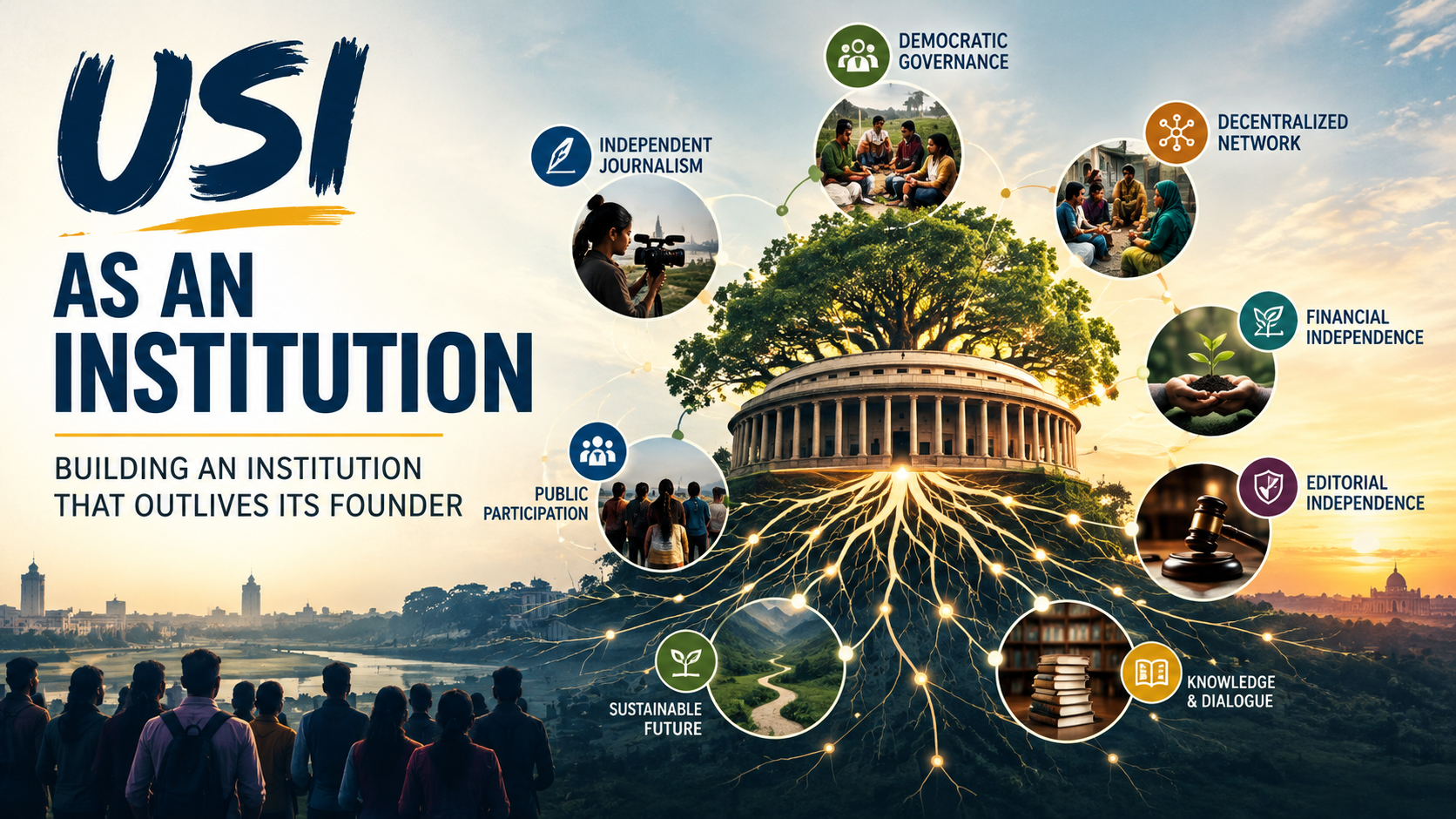
Building an Institution That Outlives Its Founder

BECOME A NANAK MEDIA FELLOW

Transform your smartphone into a tool for journalism.

The Nanak Media Fellowship is the core of USI’s media-network model.

DONATE VIA UPI

Please use only the verified payment information published on this website.

Before making a contribution through a QR code, check that you are on the official USI website, usofindia.com, which redirects to https://unitedstatesofindia.livezenlife.com/unitedstatesofindia/.


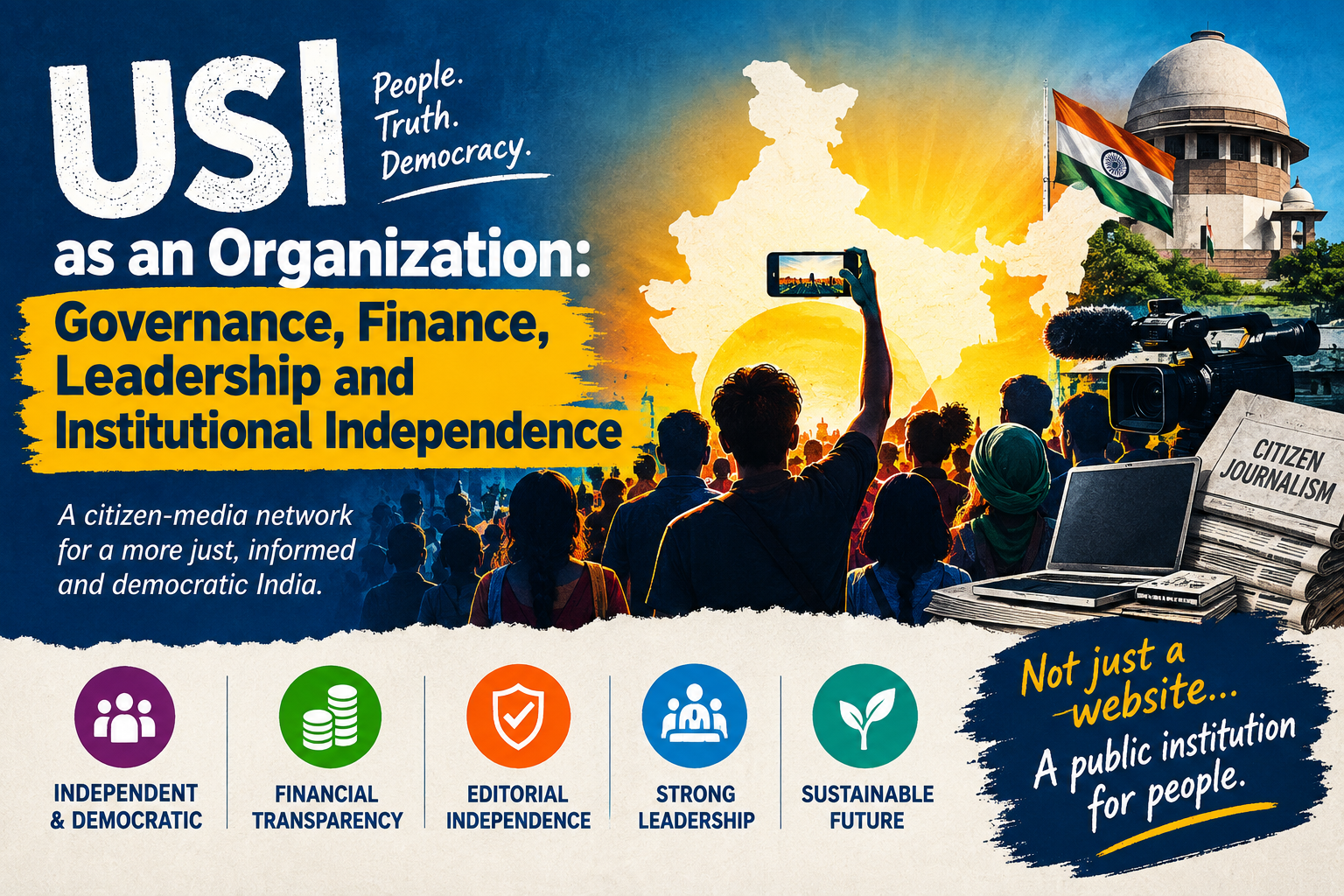
USI as an Institution: Governance, Finance, Leadership, and Institutional Independence

An idea breathes its fullest life when it continues to thrive long after its creator has first given it voice.
United States of India (USI) is not destined to be a mere website, a passing campaign, a media project, or a founder’s personal spotlight.
It is intended to become an independent, democratic, and sustainable public-interest institution.
Such a bold vision arrives hand in hand with a daunting challenge.
How can an organization devoted to decentralization avoid becoming centralized?
How can an organization committed to challenging concentrations of power prevent power from accumulating within itself?
How can a citizen-media network remain independent when it needs money, technology, legal Support, and organizational leadership?
How can an institution survive the departure of its founder?
These questions are not secondary to USI.
They are stitched into the very fabric of this endeavor.

From an individual’s vision to a public institution

Writer and independent researcher Yang Burzhome initiated USI.
Every institution’s journey begins with the founder’s guiding hand.
Someone has to articulate the idea, build the initial infrastructure, recruit people, establish standards, and take responsibility for turning an abstract concept into an operational project.
But a democratic institution cannot remain permanently dependent upon its founder.
USI’s founding principle is therefore:
Build an institution that does not depend upon its founder.
The founder’s role is transitional and organizational.
The objective is to create systems, people, and institutions capable of collectively continuing the mission.
True success will be marked not by the founder’s necessity, but by the day the founder’s presence is no longer required.

A non-profit public-interest institution

USI’s long-term institutional model is a non-profit organization dedicated to public-interest communication, citizen journalism, democratic participation and knowledge production.
Its purpose is not the private enrichment of an owner.
The institution’s core assets must forever serve the public mission.
This does not mean that USI cannot generate revenue.
No organization can sustain itself without resources.
It may need to pay:
  • trainers;
  • editors;
  • technical staff;
  • journalists;
  • translators;
  • administrators;
  • legal professionals;
  • security specialists;
  • designers;
  • researchers;
  • and other workers.
The real question is not the presence of money.
The question is who controls the money, where it comes from, how it is used, and whether financial dependence compromises editorial independence.

Financial independence is part of editorial independence.

The government can pressure a media organization that depends entirely on it.
An organization dependent upon a corporation may face pressure from corporate interests.
An organization dependent upon political parties can become politically subordinate.
An organization dependent on a single wealthy individual can become an extension of that individual’s preferences.
USI must therefore construct a financial foundation supported by many pillars.
Possible sources of institutional revenue may include:
  • individual donations;
  • memberships;
  • philanthropic grants;
  • institutional partnerships;
  • educational programs;
  • training fees where appropriate;
  • research and documentation projects;
  • publication-related revenue;
  • ethical sponsorships;
  • and other legally compliant public-interest sources.
No single source of funding should ever hold enough sway to buy editorial influence.

Financial transparency

Winning public trust requires more than declarations of independence.
USI should publish meaningful financial information.
As the organization develops, it should aim to disclose:
  • major sources of funding;
  • broad categories of expenditure;
  • grants and institutional partnerships;
  • conflicts of interest;
  • related-party transactions;
  • executive compensation where applicable;
  • and significant financial relationships that could affect public confidence.
Transparency is not a matter of piling on bureaucracy.
It is to answer a simple public question:
Who pays for this work?
Citizens have a right to know.

Editorial independence from donors

Financial supporters should not determine editorial conclusions.
A donor may support USI because they believe in citizen journalism.
A foundation may support multilingual documentation.
An individual may support environmental reporting.
A philanthropic institution may support training.
But financial support should not purchase:
  • favorable coverage;
  • suppression of criticism;
  • editorial approval;
  • control over Fellows;
  • influence over investigations;
  • or the right to determine conclusions.
USI should therefore establish a written funding and editorial-independence policy before significant institutional fundraising begins.

Women-led governance

USI’s long-term institutional vision is a women-led and women-owned Indian non-profit organization.
This is intended as an institutional principle rather than symbolic representation.
Women should have meaningful authority over:
  • governance;
  • editorial policy;
  • organizational strategy;
  • finance;
  • fellowship administration;
  • institutional development;
  • and leadership succession.
The aim is to create an enduring institution where women do not merely participate, but lead as decision-makers.
The organization should explain publicly how this principle will operate in its governing documents.
A principle becomes meaningful when it is translated into:
rules + representation + authority + accountability.

Distributed leadership

USI does not envision a permanent command structure centered on one individual.
The organization should gradually develop several layers of leadership:
Institutional governance
Responsible for legal, financial and strategic accountability.
Editorial leadership
Responsible for journalism standards, publication and editorial independence.
Fellowship leadership
Responsible for recruitment, training, assessment and mentorship.
Regional leadership
Responsible for supporting local chapters and Fellows.
Community-level leadership
Responsible for local communication networks and community relationships.
Sharing leadership is not about abandoning coordination.
It is about making sure that coordination never slips into domination.

Leadership succession

Institutional continuity must be designed before it is needed.
If a chief organizer becomes unavailable due to resignation, illness, arrest, displacement, death, or another circumstance, the organization should not collapse.
Succession should therefore be built into the institution.
Every critical organizational function should have:
  • documented procedures;
  • trained successors;
  • accessible records;
  • shared institutional knowledge;
  • secure credentials;
  • financial controls;
  • and continuity plans.
The principle is straightforward:
The mission must endure beyond any single individual.

Decentralization

USI envisions a decentralized institutional structure.
Picture it as mycelium: a living network of countless interconnected nodes, never anchored to a single visible center.
The network might eventually connect:
National institution → state networks → district networks → local communities.
A local chapter should possess sufficient autonomy to respond to local realities.
At the same time, decentralization does not mean that every part of USI operates under completely different standards.
There must be common rules concerning:
  • journalism;
  • verification;
  • safeguarding;
  • finances;
  • conflicts of interest;
  • data protection;
  • digital security;
  • use of the USI identity;
  • and accountability.
The model is therefore:
Distributed authority + common standards.

Accountability within the organization

An organization that challenges the powerful must also be prepared to shine that same light inward.
USI should establish mechanisms through which Fellows, staff, sources and members of the public can raise concerns.
These mechanisms may eventually include:
  • an editorial complaints process;
  • correction requests;
  • conflict-of-interest disclosure;
  • financial complaints;
  • safeguarding complaints;
  • Fellow disciplinary procedures;
  • independent review mechanisms;
  • and an appeals process.
The organization should distinguish between:
good-faith error
and
deliberate misconduct.
An honest mistake should normally trigger correction and learning.
Deliberate fabrication, harassment, manipulation of evidence, or serious ethical misconduct should trigger stronger action.

The founder’s relationship with the institution

The founder should not be beyond institutional accountability.
If USI is to become a democratic institution, the same principles that apply to everyone else must apply to its founder.
The founder may have a special historical role.
That does not create permanent editorial authority.
The founder may express personal political opinions.
That does not make those opinions automatically the institutional position of USI.
The founder may write commentary.
That does not make commentary journalism.
The distinction between:
founder
editor
journalist
organizer
board member
and
institution
Must become increasingly clear as USI grows.

Protecting the institution from political capture

USI is concerned with democratic participation and public accountability.
It will inevitably operate in a political environment.
That does not mean it should become a political party.
USI should be able to report critically on governments regardless of which party is in power.
It should be able to document wrongdoing by supporters and opponents of the same political position.
It should not require Fellows to support a political party or candidate.
The organization should make a clear distinction between:
USI’s democratic values
and
partisan political allegiance.
The former can define the institution.
The latter should not determine membership or journalistic standing.

Institutional independence and press freedom

USI’s commitment to epistemic freedom must extend beyond its own network.
The organization should defend the legitimate journalistic rights of journalists even when their editorial positions differ from USI’s.
This is not merely generosity.
It is a logical consequence of believing in press freedom.
A democratic media institution cannot reasonably demand freedom for itself while denying legitimate journalistic freedom to others.
USI’s institutional standard should therefore be:
Protect press freedom even when we disagree with the journalism being protected.

An institution that belongs to the public

The ultimate test of USI’s organizational model will not be how impressive its founding manifesto sounds.
It will be whether the institution can demonstrate:
  • transparent governance;
  • responsible financial management;
  • editorial independence;
  • leadership succession;
  • protection of Fellows;
  • accountability;
  • institutional memory;
  • and public trust.
With time, the organization should step out from the founder’s shadow.
It should become larger than its website.
It should become larger than its first generation of Fellows.
It should transform into a public institution with the strength to renew itself time and again.
That is the institutional ambition of USI:
Not to build an organization around a founder, but to build an institution capable of carrying a democratic idea beyond its founder.

Caveat

EDITORIAL INDEPENDENCE & POLITICAL CAVEAT

BECOME A NANAK MEDIA FELLOW

Transform your smartphone into a tool for journalism.

The Nanak Media Fellowship is the core of USI’s media-network model.

DONATE VIA UPI


Please use only the verified payment information published on this website.

Before making a contribution through a QR code, check that you are on the official USI website, usofindia.com, which redirects to https://unitedstatesofindia.livezenlife.com/unitedstatesofindia/.

USI IS NON-PARTISAN — NOT VALUE-FREE

United States of India (USI) is a non-partisan, people-oriented, public-interest media initiative.

We are not affiliated with, owned by, or controlled by any political party.

We do not endorse candidates or political parties.

We do not ask our readers or Fellows to vote for a particular party.

We do not believe that journalism should become an extension of electoral politics.

But non-partisan does not mean value-free.

USI has a clearly stated set of public-interest commitments. We are pro-people, pro-woman, attentive to marginalized communities, and committed to examining caste inequality and the experiences of Avarna communities.

We believe that human dignity, equality, freedom, social justice, democratic accountability, institutional independence, and the right of people to tell their own stories are legitimate subjects of public-interest journalism.

These commitments determine what we consider important to investigate and whose voices deserve to be heard.

They do not determine the factual conclusion of a story.

That distinction is fundamental to USI.

WHAT DOES “NON-PARTISAN” MEAN?

For USI, non-partisanship means that our journalism is not determined by loyalty to a political party, candidate, government, opposition group, ideological organization, corporation, donor, or other powerful interest.

USI may criticize a government.

USI may investigate an opposition party.

USI may examine the actions of a corporation.

USI may question a social movement.

USI may report on a religious institution.

USI may investigate an organization whose objectives broadly overlap with USI’s own values.

And USI may also publish information favorable to an institution, party, government, or organization when the evidence warrants it.

Agreement does not earn favorable coverage. Disagreement does not justify unfavorable coverage.

Our editorial standards must apply to everyone.

NON-PARTISAN DOES NOT MEAN POLITICALLY INDIFFERENT

A common misunderstanding of neutrality is that a journalist must stand emotionally or morally nowhere.

USI does not subscribe to that idea.

If a community experiences discrimination, we believe it warrants investigation.

If women face violence or exclusion, that deserves public attention.

If a marginalized community is absent from the public record, that absence itself may deserve investigation.

If a government agency exercises public power, its actions can legitimately be scrutinized.

If a corporation affects the lives or livelihoods of large numbers of people, its conduct can legitimately be investigated.

If a political party makes a claim, that claim can be examined.


Public-interest journalism does not become partisan merely because it examines power or gives visibility to people who have historically received less attention.

Our question is not:

“Which political side does this story help?”

Our first questions are:

What happened?

What evidence exists?

Who is affected?

Who has power?

Whose experience has been overlooked?

What does the evidence show?


USI IS PRO-PEOPLE

“Pro-people” is one of the central values of USI.

By this we mean that the lives, dignity, safety, livelihoods, rights and experiences of ordinary people should matter in public discourse.

People should not be reduced to statistics, vote banks, consumers, beneficiaries, victims or political constituencies.

They are participants in society.

They have knowledge about their own lives.

They have the right to be heard.

This is closely connected with USI’s broader idea of epistemic freedom:

People should have the ability to participate in producing the knowledge that shapes their communities.

USI therefore seeks to create opportunities for people to document their own communities through the Nanak Media Fellowship and the wider USI media network.

But being pro-people does not mean automatically believing every claim made by a member of the public.

We will listen without prejudice and verify without contempt.

A person’s testimony deserves to be heard.

A factual assertion still requires appropriate verification.


USI IS PRO-WOMAN

USI is explicitly pro-woman.

We understand this commitment to mean support for women’s:

  • dignity;
  • equality;
  • safety;
  • freedom;
  • economic independence;
  • political participation;
  • access to knowledge;
  • freedom from discrimination;
  • ability to tell their own stories;
  • ability to participate in public life.

Women’s experiences should not be treated as secondary subjects.

At the same time, being pro-woman does not mean that every claim made in the name of women is automatically accepted as fact.

Women, like everyone else, deserve journalism based on evidence, fairness and accountability.

Our commitment to women is a commitment to their equal dignity and agency — not a substitute for editorial verification.

USI also seeks to develop institutional structures in which women have substantial leadership, ownership and decision-making authority.

Our long-term objective is a women-led and women-owned nonprofit institution, subject to the establishment of the appropriate legal and governance structure.

USI AND MARGINALIZED COMMUNITIES

USI intends to pay particular attention to communities that have historically had limited access to institutional media and knowledge-producing structures.

This includes, among others:

  • Dalits;
  • Adivasis and Indigenous communities;
  • Bahujan communities;
  • marginalized caste groups;
  • economically disadvantaged communities;
  • linguistic minorities;
  • remote and rural communities;
  • marginalized workers;
  • communities whose experiences are poorly represented in mainstream public discourse.

This does not mean that USI assumes that every member of a marginalized community thinks alike.

Nor does it mean that marginalized people are incapable of being questioned or criticized.


It means something simpler:

Their experiences, knowledge, and perspectives deserve access to the public record.


WHAT DOES USI MEAN BY “AVARNA”?

USI uses the term Avarna as a social and historical framework for discussing communities positioned outside or disadvantaged by traditional varna hierarchies.

Within USI’s vocabulary, the term highlights the historical relationship among caste, social exclusion, access to power, and the production of knowledge.


USI’s interest in Avarna communities is therefore not merely demographic.

It is epistemic.

Who gets to speak?

Who gets believed?

Who gets published?

Who gets represented?

Who gets to interpret society?

Who gets to define what is normal?

Who controls institutions?


These are questions of power.

USI wants to create greater space for communities that have historically had less institutional power to document and interpret their own experiences.


At the same time, USI will not treat either “Avarna” or “Savarna” as a homogeneous political category.


Individuals cannot be reduced to their caste location.


Our journalism should examine structures of caste power without assuming that every individual within a social category has identical beliefs, interests, or political behavior. Savarana are multi-ethnic, multi-cultural, and multi-racial. They hold varied political and class positions. We recognize their liberal positions.


Hence, CRITICIZING CASTE POWER IS NOT AN ATTACK ON INDIVIDUALS belonging to the Savarana caste.

USI intends to investigate caste hierarchy, discrimination, exclusion, privilege and unequal access to institutions.

That may sometimes require examining institutions or social practices associated with dominant caste groups.

Such reporting should distinguish between:

a social structure

and

the individual human beings who exist within that structure.

USI will not use caste identity as a substitute for evidence.

We will not assume that every person belonging to a socially privileged group supports discrimination.

Nor will we assume that every person belonging to a historically marginalized group shares the same political position.

Our subject is power, evidence and lived reality.


THE SAME EDITORIAL STANDARD APPLIES TO EVERYONE

USI may investigate:

  • the Union government;
  • state governments;
  • political parties;
  • opposition parties;
  • elected representatives;
  • courts and public institutions;
  • law-enforcement agencies;
  • corporations;
  • religious organizations;
  • caste organizations;
  • NGOs;
  • activist organizations;
  • media organizations;
  • universities;
  • civil-society institutions;
  • USI itself.

No organization receives immunity because it agrees with our values.

No organization becomes a legitimate target merely because it disagrees with us.

The powerful should expect scrutiny.

The marginalized should expect to be heard.

Everyone should expect evidence.


USI DOES NOT PROMISE “BALANCE” AT THE EXPENSE OF TRUTH

USI does not believe that every controversy can be resolved by giving exactly equal space to every position.

Evidence does not always divide neatly into 50–50 proportions.

If credible evidence overwhelmingly supports one factual proposition, presenting an unsupported contrary claim as its equal merely to create the appearance of “balance” can mislead the public.


At the same time, USI will distinguish between:

fact

testimony

allegation

opinion

interpretation

analysis

and

verified evidence.

Readers should be able to understand which is which.


EMIC PERSPECTIVE DOES NOT MEAN UNCRITICAL ACCEPTANCE


USI’s media philosophy emphasizes an emic perspective — understanding social reality from the perspective of the people who experience it.


This is particularly important when reporting on communities that are frequently described by outsiders.


But an emic perspective is not a license to abandon verification.

A community’s account of its experience may reveal something that outsiders have failed to see.


That account should be taken seriously.

It should then be investigated using appropriate evidence.

Therefore:

Emic perspective. Independent verification.

This is one of the foundational principles of USI journalism.


FACT, ANALYSIS AND OPINION

USI will seek to distinguish different forms of published material.

NEWS AND REPORTING

What happened, based on available evidence.

TESTIMONY

What a person or community says happened to them.

ANALYSIS

An evidence-based interpretation of events and their significance.

OPINION

A clearly identified argument or viewpoint.

INVESTIGATION

Reporting that attempts to establish facts that may not otherwise be readily visible.

COMMENTARY

A writer’s interpretation or argument, which should not be mistaken for independently established fact.

Readers should not have to guess whether they are reading a verified report or an author’s interpretation.


OFFICIAL STATEMENTS ARE CLAIMS TOO

USI will not automatically treat a government press release, corporate statement, police statement, political speech, institutional announcement or activist statement as established fact merely because it comes from an authoritative source.


An official statement is evidence of what that institution says.

It may or may not establish what actually happened.

Where appropriate, USI will seek:

  • documentary evidence;
  • independent sources;
  • eyewitness testimony;
  • expert analysis;
  • publicly available records;
  • court documents;
  • official data;
  • photographs or video;
  • other verifiable material.

The appropriate level of verification will depend on the nature of the claim.


THE RIGHT OF RESPONSE

People and institutions criticized in USI reporting should, where reasonably possible, have an opportunity to respond to substantive allegations.


A response does not have to be accepted as true.


But the opportunity to respond is part of fair journalism.


If an institution declines to respond, USI may report that it was approached but did not respond.

Where a response materially changes the factual understanding of a story, the reporting should reflect that.


USI CAN BE WRONG

No journalist, editor, researcher or institution is infallible.

USI can make mistakes.

Our commitment, therefore, is not to claim perfection.

It is to create a culture in which errors can be identified and corrected.

When credible evidence demonstrates that USI has published a factual error, we will seek to:

  • correct it;
  • acknowledge the correction;
  • preserve transparency about what changed;
  • avoid silently altering material when the change is substantively important.

Correction is not weakness.

It is part of editorial accountability.


USI’S POLITICAL INDEPENDENCE

USI is not an electoral campaign organization.

We do not endorse candidates.

We do not instruct readers how to vote.

We do not accept political funding in exchange for editorial influence.

We do not promise favorable coverage to political parties.

A political party, candidate or elected representative may be reported on because their actions are relevant to the public interest.

But coverage does not constitute endorsement.

Likewise, criticism of a political party does not automatically constitute support for its opponents.

USI’s loyalty is to its editorial principles, not to an electoral organization.


NO PARTY GETS A PERMANENT ALLY

USI may agree with a political party on one issue and disagree with it on another.

It may support a particular policy objective while criticizing the way a party attempts to achieve it.

It may publish criticism of a government while acknowledging an action that is supported by evidence.

It may publish criticism of an opposition party even when that party shares some of USI’s stated values.

This is normal for an independent publication.

USI does not need a permanent political enemy.

It needs permanent editorial standards.


DONORS DO NOT BUY EDITORIAL INFLUENCE

The same principle applies to financial supporters.

A donor cannot purchase:

  • favorable coverage;
  • suppression of criticism;
  • editorial approval;
  • control of an investigation;
  • political endorsement;
  • preferential publication;
  • removal of inconvenient reporting.

This principle is also stated in USI’s Support framework.

Money supports infrastructure. It does not purchase journalism.

Diversified revenue is intended to reduce institutional dependence on any single donor, advertiser, political organization or patron.


ADVERTISERS DO NOT BUY JOURNALISM

USI may eventually generate revenue through advertising, sponsorships, affiliate relationships, digital products, memberships, services and other lawful activities.


Commercial relationships must remain distinct from editorial decisions.

Advertising should be identifiable as advertising.

Sponsored material should be appropriately disclosed.

An advertiser should not have the right to dictate independent editorial coverage merely because it provides financial support.

Revenue must sustain journalism, not control it.


THE FOUNDER IS NOT THE INSTITUTION

USI was founded by Yang Burzhome, an independent researcher, writer, and self-taught cultural anthropologist.

His personal writings, opinions, research interests, or political observations should not automatically be treated as the editorial position of every USI contributor.

USI is intended to develop into an institution capable of functioning independently of its founder.

That means developing:

  • distributed leadership;
  • editorial safeguards;
  • transparent finances;
  • documented governance;
  • independent accountability;
  • succession mechanisms;
  • clear separation between personal and institutional views.

The founder may start the institution. The institution must ultimately outlive the founder.


USI WILL ALSO SCRUTINIZE ITSELF

Institutional independence requires self-examination.

USI may make mistakes in:

  • editorial judgment;
  • verification;
  • language;
  • interpretation;
  • financial administration;
  • Fellowship management;
  • governance;
  • technology;
  • communication.

When credible concerns are raised, they should be examined rather than dismissed simply because they are inconvenient.

Readers, Fellows, contributors and supporters should be able to question USI.

A public-interest institution that cannot tolerate scrutiny of itself cannot credibly demand accountability from others.


WHAT USI DOES NOT MEAN BY “PRO-PEOPLE”

Being pro-people does not mean:

  • believing every allegation;
  • opposing every government;
  • supporting every protest;
  • defending every activist;
  • agreeing with every community leader;
  • rejecting every corporation;
  • treating every institution as corrupt;
  • assuming every marginalized person is right;
  • assuming every powerful person is wrong.

It means that people and their interests deserve serious consideration.

Evidence determines factual conclusions.


WHAT USI DOES NOT MEAN BY “PRO-WOMAN”

Being pro-woman does not mean:

  • accepting every allegation without verification;
  • treating men as inherently responsible for wrongdoing;
  • assuming every disagreement is misogyny;
  • abandoning due process;
  • ignoring evidence that complicates a preferred narrative.

It means that women’s equality, dignity, safety and agency are legitimate public-interest concerns.

Fairness and evidence remain applicable to everyone.


WHAT USI DOES NOT MEAN BY “PRO-AVARNA”

Being attentive to Avarna communities does not mean:

  • treating all Savarna individuals as enemies;
  • assuming all Avarna individuals share the same political views;
  • replacing evidence with caste identity;
  • excusing wrongdoing because the accused belongs to a marginalized group;
  • turning journalism into caste-based propaganda.

It means recognizing that caste can affect access to power, institutions, representation and knowledge — and that these structures deserve investigation.

USI seeks to challenge exclusion without creating new forms of dehumanization.


OUR EDITORIAL FORMULA

USI’s political and editorial philosophy can therefore be summarized as:

NON-PARTISAN IN POLITICS

No party loyalty.

No candidate endorsement.

No electoral instructions.

PRO-PEOPLE IN PURPOSE

People’s dignity, rights, livelihoods and experiences matter.

PRO-WOMAN IN PRINCIPLE

Women’s equality, dignity, safety and agency matter.

ATTENTIVE TO MARGINALIZED COMMUNITIES

Those historically excluded from institutional media deserve meaningful access to the public record.

PRO-AVARNA IN REPRESENTATION

USI seeks to expand the ability of communities disadvantaged by caste structures to tell and interpret their own stories.

INDEPENDENT IN JOURNALISM

Evidence, verification, fairness and editorial judgment remain essential.


OUR COMMITMENT TO THE PUBLIC

USI does not ask readers to trust us because we use the words “independent,” “non-partisan” or “people-powered.”

Trust must be earned through practice.

We therefore aim to demonstrate our independence through:

Evidence before assertion.

Verification before publication where verification is possible.

Context rather than sensationalism.

Right of response.

Corrections when we are wrong.

Transparency about funding.

Separation of editorial and commercial interests.

No political party ownership or editorial control.

Protection of the independence of Fellows.

Respect for the dignity of people we report about.

Willingness to scrutinize institutions — including ourselves.


THE PRINCIPLE THAT GUIDES US

USI does not seek to create a journalism in which everyone is forced to agree.

It seeks to create a public space in which more people can participate in producing knowledge about the society in which they live.

That requires disagreement.

It requires questioning authority.

It requires listening to communities that have been ignored.

It requires investigating powerful institutions.

It requires challenging unsupported claims — including claims made by people with whom we sympathize.

And it requires the intellectual humility to say:

We may be wrong. Show us the evidence.


INDEPENDENCE IS A PRACTICE

USI’s independence cannot be established by a declaration on a webpage.

It must be demonstrated over time.

If we criticize a government, we should be able to explain why.

If we defend a community, we should be able to explain the evidence and principle involved.

If we publish an allegation, we should identify it as an allegation.

If we make an error, we should correct it.

If a donor disagrees with our reporting, our editorial standards should remain unchanged.

If a political party praises our work, that should not make us its ally.

If a political party attacks our work, that should not make it our enemy.

That is what non-partisanship means to USI.


OUR CAVEAT IN ONE SENTENCE

USI is non-partisan but not value-free; pro-people, pro-woman, and attentive to marginalized and Avarna communities, while remaining committed to evidence, verification, fairness, editorial independence, and the right of every subject to be heard.

Listen without prejudice.

Verify without contempt.

Challenge power without becoming its mirror.

Give people a voice without giving up the obligation to seek the truth.

That is the editorial independence USI intends to build.
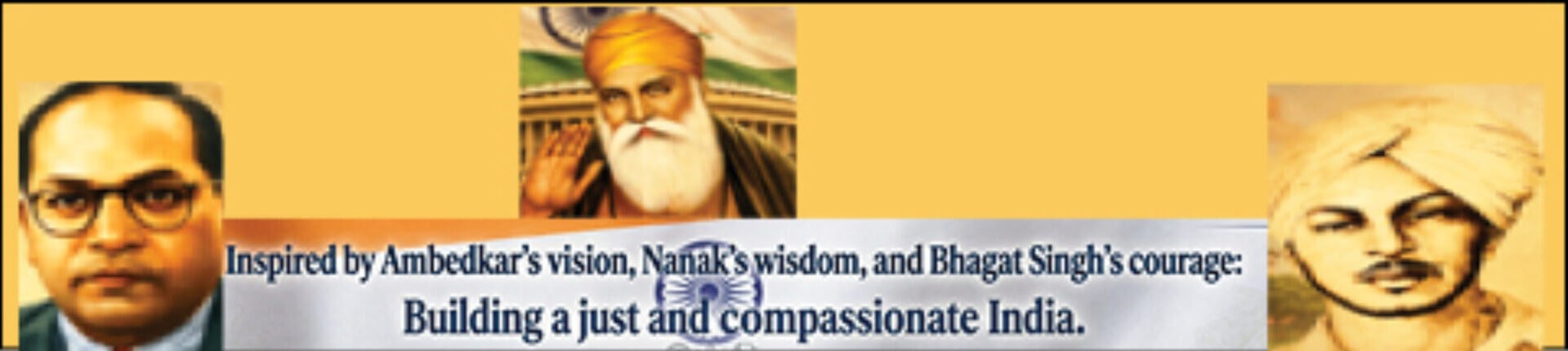


Online Registeration Form for Nanak Media Fellows


Before you scan the QR code, please check your browser’s address bar. It should read ” /unitedstatesofindia ” as it is shown below


Become a Nanak Media Fellow, it is free.

However, a small contribution shall be appreciated.


Apply for Nanak Media Fellowship via Google Form here


Who Should Apply?

You should consider applying if you have ever thought:

“Something important is happening here, but nobody is reporting it.”

Perhaps your community is experiencing problems in education, employment, agriculture, the environment, infrastructure, local government, culture, youth, public services, or social issues.

Perhaps you simply want to learn how to use your Smartphone to tell people’s stories.

That is exactly the kind of curiosity we are looking for.


How to Apply for the Nanak Media Fellowship

The application is completed online.

You will not be asked to provide your complete residential/physical address initially. For basic geographic identification, we primarily ask for your state and district.

Step 1 — Check your eligibility

Before applying, make sure that initially:

  • you are 18 or older;
  • you have regular Smartphone access;
  • you can access the internet;
  • you are willing to learn online; and
  • You are prepared to adhere to responsible journalism standards.

Step 2 — Complete the online application

The application asks about:

  1. Personal information
  2. State and district
  3. Languages
  4. Smartphone and internet access
  5. Computer skills
  6. Media and journalism experience
  7. Community interests
  8. Social-media presence
  9. Video, editing, subtitling, dubbing, and voice-over skills
  10. Online learning availability
  11. Journalistic judgment
  12. Safety and privacy
  13. Additional skills and volunteering
  14. Your motivation for joining NMF


Step 3 — Tell us about your community

We want to know what you think deserves greater public attention.

You may be asked to identify three issues in your district that you believe receive insufficient media attention and describe one story that you think should be reported.


Step 4 — Tell us what you can already do

Don’t worry if you have limited technical skills.

Tell us honestly whether you can:

  • record video;
  • edit video;
  • livestream;
  • photograph events;
  • interview people;
  • write scripts;
  • translate;
  • subtitle;
  • dub;
  • provide voice-over;
  • manage social media; or
  • use AI-assisted media tools.

You don’t have to know everything. You have to be willing to learn.


Step 5 — Demonstrate your journalistic judgment

The application includes practical questions—for example, what you would do if someone sent you an unverified WhatsApp video claiming that a serious incident had occurred.

These questions are not academic examinations.

They are intended to understand whether you appreciate the importance of:

verification → evidence → fairness → correction → responsible publication.


Step 6 — Submit the application

After submitting your application, you should receive a confirmation.

Submission does not automatically guarantee selection.

Depending on the fellowship’s requirements, shortlisted applicants may subsequently be invited for:

  1. application review;
  2. online orientation or interview;
  3. basic Smartphone/media assessment;
  4. fellowship admission;
  5. online training;
  6. practical reporting assignments; and
  7. final assessment/certification and applicable Press ID eligibility.

What We Are Looking For

We are not primarily looking for:

degrees, impressive résumés, or large follower counts.

We are looking for people who are:

Curious.

Observant.

Connected to their communities.

Willing to learn.

Comfortable using a smartphone—or willing to become so.

Interested in listening to people.

Committed to accuracy.

Willing to verify information.

Prepared to accept the responsibilities of citizen journalism.

The Nanak Media Fellowship is ultimately about transforming ordinary citizens from passive consumers of information into active producers of responsible public knowledge.

Your phone can be your camera.

Your community can be your newsroom.

Your language can become a bridge between communities.

Your reporting can become part of India’s public record.

Google Forms Master Application

I have compiled the complete application form as an editable Word document that you can use as the master copy while creating the actual Google Form.

Download the Nanak Media Fellowship Google Forms Master Application

It includes the full structure, question types, required/optional status, eligibility questions, social media fields, equipment questions, language section, journalistic judgment scenarios, safety questions, volunteering section, and applicant declaration.

Who Can Apply for the Nanak Media Fellowship?

The Nanak Media Fellowship (NMF) is open to anyone who wants to learn citizen journalism and help document the events, experiences and issues affecting their community.

You do not need to be a professional journalist.

You do not need a university degree.

You do not need previous media experience.

What matters most is your curiosity, willingness to learn, community awareness, ability to use a Smartphone, and commitment to responsible journalism.

 Basic eligibility

You can apply if:

  • You are 18 years of age or older.
  • You have regular access to a Smartphone capable of recording video, taking photographs, and accessing the internet.
  • You are willing to participate in online training.
  • You are willing to learn Smartphone journalism, video production, livestreaming, and digital publishing.
  • You are interested in the issues affecting your community.
  • You are willing to verify information before publishing it.
  • You agree to follow Nanak Media’s standards concerning accuracy, fairness, privacy, safety and responsible reporting.

 Your educational background does not matter.

The fellowship is deliberately designed to be accessible to people from different educational and socioeconomic backgrounds.

You may be a:

  • student;
  • farmer;
  • worker;
  • shopkeeper;
  • homemaker;
  • professional;
  • community volunteer;
  • photographer;
  • YouTuber;
  • blogger;
  • social-media creator;
  • activist;
  • local storyteller; or
  • someone who has never worked in media before.

A degree is not a substitute for curiosity, and a lack of formal education is not a barrier to becoming a responsible citizen journalist.

Your Smartphone is your first newsroom.

You do not need an expensive professional camera.

A reasonably capable Smartphone can become your:

camera + audio recorder + editing device + newsroom + broadcasting station.

You should be willing to learn how to use it for:

  • video recording;
  • photography;
  • interviews;
  • livestreaming;
  • video editing;
  • captions and subtitles;
  • voice-over;
  • dubbing;
  • social-media publishing; and
  • AI-assisted media production.

Language skills are valuable.

Nanak Media is intended to operate across India’s linguistic diversity.

We particularly welcome people who can speak, read, or write Indian languages and report events in the language used by their communities.

Skills in:

  • translation;
  • proofreading;
  • subtitling;
  • dubbing; and
  • voice-over

are especially valuable.

 Your community matters more than your follower count.

You do not need thousands of followers to apply.

Someone with 100 followers who knows their community well may have greater potential as a citizen journalist than someone with 100,000 followers who has little connection with local issues.

We want people who can answer:

 “What is happening in my community that people outside it need to know about?”


How To Earn a Living as a Nanak Media Fellow

HOW NANAK MEDIA FELLOWS CAN BUILD A SUSTAINABLE MEDIA LIVELIHOOD

BECOME A NANAK MEDIA FELLOW

Transform your smartphone into a tool for journalism.

The Nanak Media Fellowship is the core of USI’s media-network model.

DONATE VIA UPI


Please use only the verified payment information published on this website.

Before making a contribution through a QR code, check that you are on the official USI website, usofindia.com, which redirects to https://unitedstatesofindia.livezenlife.com/unitedstatesofindia/.

From Citizen Journalism to Economic Self-Reliance

A central objective of the Nanak Media Fellowship is not simply to train people to produce journalism.


It is to help create the conditions in which people can build sustainable livelihoods from their own media skills, local knowledge, reporting, storytelling, and audiences.

USI does not want citizen journalism to become permanent unpaid labor.

At the same time, we do not want to promise income that cannot be guaranteed.

Platform monetization, advertising, sponsorships, affiliate income, commissions, assignments, and other opportunities depend on audience development, eligibility requirements, quality of work, market conditions, platform policies, and many other factors.

USI’s role is to build the network, skills, infrastructure, training, distribution opportunities, and revenue pathways that can help Fellows develop those opportunities.

The long-term objective is:

Build the journalism. Build the audience. Build the skills. Build the revenue. Build greater self-reliance.


THE NANAK MEDIA ECONOMIC MODEL

The model is designed around a simple cycle:

TRAIN

↓

REPORT

↓

PUBLISH

↓

BUILD AN AUDIENCE

↓

GENERATE REVENUE

↓

Support THE FELLOW

↓

REINVEST IN SKILLS AND JOURNALISM

This is not a guaranteed-income scheme.

It is an attempt to create an economic ecosystem around independent community journalism.

The more capable Fellows become at reporting, production, translation, audience development, and digital publishing, the more opportunities they may be able to pursue.


1. BUILD YOUR OWN MEDIA PRESENCE

Every Nanak Media Fellow should be encouraged to develop an independent digital presence appropriate to their work.

This may include:

  • YouTube
  • Instagram
  • Facebook
  • Podcasts
  • Personal websites
  • Newsletters
  • Other appropriate publishing platforms

The Fellow’s identity and relationship with their audience should remain important.

USI is not intended to replace the Fellow’s own media identity with a centralized USI identity.

Instead, USI should function as network infrastructure and an additional distribution channel.

A Fellow might therefore have:

Their own channel + their own audience + USI distribution + network collaboration

Rather than depending on a single institution for all visibility.


2. YOUTUBE AND PLATFORM MONETIZATION

YouTube and other digital platforms may provide revenue opportunities once a creator meets the applicable eligibility requirements.

These requirements are determined by the individual platform and may change over time.

Therefore:

USI does not guarantee platform monetization.

A Fellow’s ability to generate platform revenue may depend on factors such as:

  • Eligibility requirements
  • Audience size
  • Watch time or other platform metrics
  • Content policies
  • Geographic availability
  • Advertising demand
  • Platform decisions
  • The type and quality of content produced

USI can help Fellows understand these systems, improve their production skills, develop audiences, and create content that complies with applicable rules.

Where a Fellow independently monetizes their own eligible channel, the resulting platform revenue belongs to the Fellow, subject to the platform’s terms and any applicable Fellowship agreement.


3. ORIGINAL REPORTING CAN BECOME A MEDIA ASSET

A strong local report can have a life beyond a single social-media post.

A Fellow may develop:

  • Short news reports
  • Video documentaries
  • Interviews
  • Investigative features
  • Local history documentaries
  • Environmental reporting
  • Community stories
  • Cultural documentation
  • Podcasts
  • Photo stories
  • Explainer videos
  • Multilingual productions

Some material may eventually be suitable for licensing, syndication, documentary distribution, educational use, or other lawful media opportunities.

USI may help Fellows understand how to package and distribute such work.

Potential distribution opportunities could include domestic or international media organizations and digital platforms.

No distribution opportunity is guaranteed.

The objective is to create high-quality local journalism that can travel beyond its original community.


4. FREELANCE MEDIA AND RESEARCH WORK

The skills acquired through the Fellowship may also create opportunities beyond the Fellow’s own channel.

Depending on their skills and professional development, Fellows may pursue:

  • Freelance journalism
  • Video production
  • Documentary work
  • Translation
  • Subtitling
  • Voiceover
  • Photography
  • Research assistance
  • Transcription
  • Social-media management
  • Digital storytelling
  • Local-language content production
  • Media production assignments

International and domestic media organizations, research institutions, NGOs, educational organizations, publishers, and other legitimate clients may sometimes commission this kind of work.

USI may help Fellows develop portfolios and professional skills so that they can seek such opportunities independently.

USI does not guarantee assignments or employment.


5. AFFILIATE REVENUE

USI may develop carefully selected affiliate arrangements involving books, educational resources, digital products, or other relevant material.

Affiliate links may appear in:

  • Video descriptions
  • Websites
  • Social-media posts
  • Newsletters
  • Podcasts
  • Other appropriate digital publications

If a visitor purchases something through an affiliate link, the applicable platform or merchant may pay a commission.

Where USI operates such a program, the relevant revenue-sharing arrangement will be disclosed to participating Fellows.

Editorial independence comes first.

A product should not be promoted merely because it generates a commission.

Affiliate relationships must be disclosed where required, and they must not determine editorial conclusions.

Revenue follows useful recommendations; it does not purchase editorial approval.


6. LOCAL ADVERTISING AND SPONSORSHIP

Local journalism can create relationships with local businesses and institutions.

Where appropriate, Fellows may be able to generate income through:

  • Local advertising
  • Sponsorships
  • Community business partnerships
  • Event promotion
  • Other lawful commercial arrangements

Such opportunities must remain clearly separated from editorial decision-making.

A business that purchases advertising does not purchase favorable journalism.

A sponsor cannot require a Fellow to suppress legitimate reporting.

A journalist cannot present paid promotion as independent reporting.

USI will develop guidelines covering:

  • Advertising disclosure
  • Sponsored content
  • Conflicts of interest
  • Political advertising
  • Misleading advertising
  • Prohibited categories
  • Separation of advertising and editorial content

Commercial revenue must never silently become editorial influence.


7. THE POWER OF THE NETWORK

One Fellow may have a small audience.

A network of thousands of Fellows can create something much larger.

USI therefore wants Fellows to help one another discover and distribute useful work.

This may include:

  • Following other Fellows
  • Watching relevant reporting
  • Sharing useful stories
  • Providing constructive feedback
  • Translating or dubbing appropriate material
  • Connecting local stories with audiences elsewhere
  • Collaborating on investigations or documentaries
  • Amplifying verified journalism

But this is important:

NETWORK PARTICIPATION MUST BE GENUINE.

USI will not require Fellows to manufacture likes, comments, subscriptions, views, or watch time merely to manipulate platform algorithms.

Artificial engagement can undermine both journalism and the network’s credibility.

Fellows should share work because it is relevant, useful, interesting, or important to their audiences.

The network should create genuine reach — not artificial numbers.


8. MULTILINGUAL JOURNALISM AS AN ECONOMIC OPPORTUNITY

India’s linguistic diversity is not simply a communication challenge.

It can also become an important part of the network’s value.

A story produced in one language can potentially be:

reported → translated → subtitled → dubbed → localized → distributed

across other linguistic communities.

A Fellow who knows a regional language may therefore contribute much more than translation.

They may provide access to a community, cultural context, local terminology, sources, and knowledge that would otherwise remain invisible.

USI wants to develop a multilingual network in which language becomes a bridge between communities rather than a barrier between audiences.


9. USI WEBSITE AND DIGITAL REVENUE

USI itself will also need sustainable revenue sources. Possible future revenue streams may include:

  • Website advertising
  • Affiliate revenue
  • Books and e-books
  • Educational materials
  • Courses
  • Journalism and media-training resources
  • Memberships
  • Digital products
  • Licensing
  • Other lawful activities

The purpose of diversification is straightforward:

USI should not depend permanently on donations from a small number of people or institutions.

At the same time, revenue-generating activity must remain consistent with USI’s public-interest purpose and editorial standards.


10. FELLOW-OWNED WORK AND USI DISTRIBUTION

Nanak Media Fellows should retain clearly defined rights in the work they create.

Where a Fellow permits USI to publish or distribute their work, the applicable Fellowship and Content Rights arrangements should specify:

  • What rights are being granted
  • Whether the license is exclusive or non-exclusive
  • Where USI may publish the work
  • How long the permission lasts
  • Whether USI may edit or translate the material
  • How attribution will be handled
  • How revenue, if any, is shared
  • What happens when the relationship ends

The objective is to help Fellows build an audience and livelihood — not to take ownership of their creative work by default.


11. BUILDING A PROFESSIONAL PORTFOLIO

A Fellow’s digital work can gradually become a professional portfolio.

Over time, a portfolio might demonstrate experience in:

  • Reporting
  • Documentary production
  • Interviewing
  • Research
  • Verification
  • Editing
  • Photography
  • Translation
  • Subtitling
  • Local-language journalism
  • Digital storytelling

This can help Fellows pursue opportunities both within and outside the USI network.

USI therefore encourages Fellows to think beyond individual videos.

Build work that demonstrates what you can do.


12. INCOME IS NOT GUARANTEED

This principle deserves to be stated clearly.

Nanak Media Fellowship is not an employment contract.

USI does not promise:

  • A fixed salary
  • Guaranteed assignments
  • Guaranteed YouTube monetization
  • Guaranteed advertising income
  • Guaranteed sponsorships
  • Guaranteed affiliate revenue
  • Guaranteed documentary sales
  • Guaranteed audience growth

Digital media is competitive and unpredictable.

USI can aim to provide training, network infrastructure, distribution opportunities, professional development, collaboration, and access to potential revenue streams.

The Fellow remains responsible for developing their own media practice and audience.


FROM Support TO SELF-RELIANCE

The relationship between the Support Us page and this page is intentional.

In the early stage, USI needs Support to build infrastructure.

That Support can help create:

Training

↓

Equipment

↓

Reporting

↓

Publishing

↓

Audience

↓

Revenue opportunities

↓

Fellow livelihood

↓

A stronger network

↓

Less dependence on donations

This is the economic logic behind USI’s model.

Don’t just fund the network.

Help the network learn to sustain itself.


WHAT MAKES THIS MODEL DIFFERENT?

Traditional media generally requires substantial institutional infrastructure before an individual can become a journalist.

USI begins from the opposite direction.

Start with the person.

Give them skills.

Give them access to technology.

Connect them with other people.

Help them build an audience.

Help them develop professional capabilities.

Create pathways for their work to generate income.

Then allow the network to grow organically.

The smartphone becomes the first piece of infrastructure.

The community becomes the first newsroom.

The network becomes the distribution system.

And the audience becomes part of the economic foundation.


THE LONG-TERM OBJECTIVE

USI’s long-term objective is to help create a network in which citizen journalism can become a viable professional activity for people who have historically lacked access to institutional media infrastructure.

This could eventually involve thousands of Fellows working across India’s regions and languages.

But growth is not the only objective.

The network must remain:

Independent.

Evidence-based.

Ethically grounded.

Economically transparent.

Respectful of copyright and creative rights.

Independent of donor and advertiser control.

Accountable to its editorial standards.

A large network without these safeguards would not fulfill USI’s purpose.


OUR ECONOMIC PRINCIPLE

USI’s economic model can be summarized in one sentence:

Create the conditions in which the people who produce valuable journalism can increasingly earn from the value they create.

That means supporting the Fellows:

skills → work → audience → reputation → opportunities → income

rather than creating permanent dependence on USI itself.

The ultimate goal is not to create thousands of people dependent on one organization.

It is to create thousands of capable people who can increasingly sustain themselves while remaining connected through a common public-interest media network.


START BUILDING YOUR MEDIA LIVELIHOOD

If you have a smartphone, a local story, a willingness to learn, and a commitment to responsible journalism, you can begin developing your media skills.

You do not need to wait until you have a television studio.

You do not need to wait for a large media organization to give you a job.

You can begin by learning to:

Observe.

Listen.

Document.

Verify.

Report.

Publish.

Build an audience.

Build a professional portfolio.

And, over time:

Build a livelihood.


BECOME A NANAK MEDIA FELLOW

Learn journalism.

Build your media skills.

Tell local stories.

Connect with a national network.

Develop your own audience.

Explore legitimate revenue opportunities.

[APPLY FOR THE NANAK MEDIA FELLOWSHIP]

[READ THE USI Support MODEL]

[READ THE EDITORIAL CHARTER]

USI does not promise you an income.

We aim to help you build the skills, network, and infrastructure to create one.

How Nanak Media Fellows Can Build a Sustainable Media Livelihood

A Citizen-Media Movement


United States of India (USI)

The people have a right to tell their own story. A citizen-media movement for epistemic freedom, democratic participation and people-to-people communication.

Introduction

Democracy is often pictured as elections, political representation, and the right to vote. These are vital, but they are only part of democracy’s deeper story.

Democracy also rests on something even more essential: who shapes the story of society, whose voices fill the public record, whose truths are heard, and who holds the power to narrate what unfolds.

United States of India (USI) begins with a simple proposition:

The people have a right to tell their own story.

USI is an attempt to turn that proposition into a democratic practice. It is built on the idea of epistemic freedom: the freedom and ability of everyday people to create, document, preserve, question, and share knowledge about the world they inhabit.

This vision stretches far beyond freedom of speech. Freedom of speech protects the right to express an opinion. Epistemic freedom asks another question: who gets to determine what becomes known in the first place?

Become a Nanak Media Fellow & Support USI

Become a Nanak Media Fellow. Transform your smartphone into a tool for journalism. The Nanak Media Fellowship is the core of USI’s media-network model.

Donate via UPI. Please use only the verified payment information published on this website. Before making a contribution through a QR code, check that you are on the official USI website, usofindia.com, which redirects to https://unitedstatesofindia.livezenlife.com/unitedstatesofindia/.

Read also:

  • United States of India as a Citizen-Media Movement: The People Have a Right to Tell Their Own Story
  • United States of India as an Organization: Building an Institution That Outlives Its Founder (Governance, Finance, Leadership and Institutional Independence)
  • United States of India Nanak Media Network: Journalism From the Ground Up (Fellows, Reporting, Publication and the Democratic Knowledge Commons)
  • Editorial Charter of United States of India: Evidence Before Assertion. Independence With Responsibility.
About the founder: Yang Burzhome

Yang Burzhome is an independent researcher, self-taught cultural anthropologist, writer, and publisher based in Delhi, India. Driven by curiosity, compassion and empathy, he immerses himself in the worlds he studies, striving to see social realities through the eyes of those who live them.

His work weaves together threads of social justice, politics, culture, philosophy, human relationships, and the creation of knowledge. Through his independent platform, LiveZenLife, he shares books, essays, and research that delve deeply into power, society, identity, and the pursuit of human freedom.

USI emerged from his passion for epistemic freedom: exploring who shapes knowledge, whose voices are heard in the public record, and how technology can empower people to connect and share their stories directly.

Yang founded USI and is now guiding its transformation from a personal vision into a transparent, independent, women-led institution dedicated to serving the public good.

He sees himself not as the institution, but as its catalyst. His long-term goal is for USI to build strong governance, financial systems, editorial safeguards, and distributed leadership that thrive independently of its founder.

The founder starts the institution. The institution must ultimately belong to the public.

Web hosting needs

At the moment, we own the official domain name usofindia.com, which redirects visitors to our page at https://unitedstatesofindia.livezenlife.com/unitedstatesofindia. However, we currently lack our own dedicated web hosting solution. Instead, we rely on a subdomain provided by the founder’s website, livezenlife.com. Unfortunately, this setup is inadequate for accommodating the high levels of traffic we anticipate.

As we prepare for the full launch of USI, we recognize the urgent need for a robust, cloud-based web hosting solution. This hosting should be scalable and capable of efficiently managing significant web traffic. Additionally, once we are operational, we plan to introduce our “Right to Reply” services via our Support Portal, further increasing our site’s demand and requiring a reliable hosting platform to support it.

From freedom of speech to epistemic freedom

A person may technically possess freedom of speech and yet remain almost completely excluded from the production of public knowledge.

  • A villager may know that a public project has displaced families but has no way to document what happened.
  • A worker may know that wages have been withheld but lack the resources to preserve evidence.
  • A woman may experience discrimination that never becomes visible outside her community.
  • A tribal community may possess generations of knowledge about a forest, river, or landscape while decisions about that landscape are made by institutions far removed from it.
  • A citizen may witness an administrative failure but have no mechanism to make that experience part of the public record.

In each case, the problem is not simply whether the person is allowed to speak. The deeper challenge is whether that person’s experience can be seen, recorded, verified, and shared as knowledge. That is the problem USI calls epistemic freedom.

Epistemic freedom means enabling ordinary citizens to:

  • observe;
  • document;
  • record testimony;
  • preserve evidence;
  • investigate public-interest questions;
  • communicate in their own languages;
  • challenge official accounts;
  • question powerful institutions;
  • preserve community histories;
  • communicate directly with fellow citizens; and
  • contribute to the public record.

The goal is not to swap one gatekeeper of knowledge (the state-aligned media) for another. USI does not ask citizens to exchange the interpretation of a single centralized media institution for one dictated by USI.

The vision reaches further: to increase the number of people who are capable of producing and evaluating knowledge for themselves.

People should not exist only as subjects in someone else’s report. For generations, large sections of society have primarily appeared in public discourse as objects of observation. Someone else describes the village. Someone else explains the community. Someone else interprets the protest. Someone else photographs the displaced family. Someone else speaks about the worker. Someone else defines the problem. Someone else decides whether the story is important enough to publish.

USI aims to turn that relationship on its head.

This does not mean that professional journalism, scholarship, universities, courts, government institutions, or established media organizations have no value. They all have important roles. It means professional authority should never hold a monopoly over reality.

People who experience an event should be able to document it. People who experience a problem should be able to investigate it. The people whose histories are disappearing should have the means to preserve them. People who speak different languages should not have to surrender their experiences to a dominant language before they become nationally visible.

This forms the bedrock of USI’s people-to-people communication model.

From vertical to horizontal communication

Much public communication is structured vertically:

  • Government → media → public
  • Political party → media → audience
  • Corporation → public-relations system → media → audience

USI proposes strengthening another direction:

  • People → people
  • Community → community
  • District → district
  • Language → language
  • Experience → experience

This does not eliminate institutions. It lessens the need to rely on them at every turn.

A citizen in Manipur should be able to communicate directly with citizens in Tamil Nadu. A worker in Maharashtra should be able to tell her story to people in Assam. A community in Kashmir should be able to communicate its experience directly to communities elsewhere in India. A local environmental struggle should not have to wait for a metropolitan newsroom to decide that it deserves national attention.

People-to-people communication is about empowering these connections to happen directly.

The Guru Nanak Way

USI draws intellectual and ethical inspiration from Guru Nanak. This is not because USI is intended to be a religious organization.

The significance lies in the principles that can be drawn from the Guru Nanak tradition: human dignity, equality, dialogue, questioning authority, communication across social boundaries, and the gathering of people in Sangat.

For USI, Sangat represents a democratic public: people gathered not merely as consumers of information but as participants in a shared process of learning, questioning and communication.

The Guru Nanak Way, therefore, provides a philosophical foundation for a horizontal model of communication. Knowledge should never be the exclusive property of rulers, priests, experts, corporations, political parties, or distant institutions.

The lived experiences of everyday people matter deeply. But USI does not romanticize lived experience. A person’s experience is important, but not automatically the whole truth. A testimony deserves to be heard without automatically becoming an established fact. This distinction is essential.

The USI model is therefore:

Lived experience → testimony → evidence → verification → public communication.

The emic approach

USI also draws on the anthropological concept of an emic approach: understanding a community from within, through the categories, experiences, and meanings that people themselves use to make sense of their lives.

This is especially important in a country as diverse as India. India cannot be adequately understood from one metropolitan perspective. The experience of a fisher community is not identical to that of an industrial worker. The experience of a tribal community cannot simply be translated into the categories of an urban policymaker. A woman living in a remote district may understand a social problem differently from a commentator sitting hundreds of kilometers away.

An emic approach begins with listening. But listening is not the end of journalism. It is the beginning.

USI seeks to blend closeness with careful verification. The closer the journalist is to a community, the greater the responsibility to maintain independence, fairness, and accuracy.

Translate the story, but let the storyteller remain visible.

A multilingual network

India’s diversity is also linguistic. A democracy that communicates only through a handful of dominant languages inevitably leaves many experiences at the margins.

USI therefore envisions a multilingual communication network. Translation, subtitling, dubbing, transcription, and speech technology can help stories travel across linguistic boundaries. But translation should never erase culture.

  • A Tamil story should remain recognizably Tamil.
  • A Kashmiri testimony should retain its context.
  • A Bengali account should not lose its cultural meaning when communicated elsewhere.
  • An Assamese environmental story should reach citizens outside Assam without becoming a generic national story stripped of its local meaning.

USI’s principle is:

Translate the story; do not erase the storyteller.

The geography of omission

USI’s editorial imagination begins with another question: what is happening that powerful institutions are failing to document adequately? This is the geography of omission. It includes places and people who are systematically less visible:

  • remote districts;
  • rural communities;
  • indigenous communities;
  • workers;
  • informal settlements;
  • marginalized castes;
  • linguistic minorities;
  • women;
  • young people;
  • displaced communities;
  • ecological frontiers; and
  • communities whose experiences rarely become national news.

Not appearing in the news does not mean something is unimportant. Often, the most vital story is the one no powerful institution has bothered to tell.

A plural India

USI’s idea of India is plural. India is multilingual, multicultural, multireligious, multiethnic, and regionally diverse. Its citizens do not need to be culturally identical to belong to the same political community.

USI sees national unity not as sameness, but as a living relationship among differences.

  • Unity through diversity.
  • Democracy through participation.
  • Freedom through knowledge.
  • Citizenship through equality.

No caste, religion, language, region, ethnicity, gender or inherited social status should confer exclusive ownership of India. India belongs equally to all its citizens.

USI is not a substitute for democracy

USI does not claim that citizen journalism can solve every democratic problem. It cannot.

  • Documentation cannot replace courts.
  • Citizen reporting cannot replace professional investigation in every circumstance.
  • A video cannot by itself establish every fact.
  • A community cannot automatically speak for every individual within it.
  • Technology does not eliminate prejudice.
  • Decentralization does not automatically produce truth.

USI sees technology as a tool, not the answer itself. The smartphone is important because it has dramatically reduced the technical barrier to documentation. But technology must be accompanied by:

training + ethics + verification + safety + independence + distribution.

That blend is the true goal.

The democratic knowledge commons

The long-term vision is a distributed body of citizen-generated knowledge. It could contain:

  • local histories;
  • oral histories;
  • photographs;
  • videos;
  • interviews;
  • public documents;
  • investigative reports;
  • environmental records;
  • records of public services;
  • accounts of people’s movements;
  • community archives; and
  • multilingual documentation.

Such a knowledge commons could serve not just today’s headlines but generations yet to come. A photograph taken today may become historical evidence tomorrow. A local interview may preserve a memory that would otherwise disappear. A recording may establish what was actually said. A series of local reports may reveal a pattern that individual incidents conceal.

USI sees journalism as more than just creating content. It is also the act of building a public record.

The principle at the heart of USI

USI does not ask citizens to believe in a new authority. It invites them to become skilled at examining authority, evidence, and competing claims on their own.

Its central proposition can therefore be stated simply:

The people have a right not only to speak, but to know, document, remember, question and communicate.

That is epistemic freedom. And that is the idea at the heart of the United States of India (USI).

Support Us

Support USI

We Don’t Just Need Your Money. We Need You.

Your support means more than money. We need your voice, your skills, and your presence.

BECOME A NANAK MEDIA FELLOW

Transform your smartphone into a tool for journalism.

The Nanak Media Fellowship is the core of USI’s media-network model.

DONATE VIA UPI

Please use only the verified payment information published on this website.

Before making a contribution through a QR code, check that you are on the official USI website, usofindia.com, which redirects to https://unitedstatesofindia.livezenlife.com/unitedstatesofindia/.


Join us in creating a media network where everyday people capture their communities, share their stories, and help shape the story of India.

United States of India (USI) is a bold experiment in people-powered media: thousands of citizens, countless stories, many languages, and technology that connects us all.

We are not here to copy the costly, top-down model of traditional media.

We are building something entirely different:

A public-interest media institution fueled by people, Guru Nanak’s wisdom, active participation, and journalism born from within its own network.

That requires money.

But money is just one piece of what we need.

We also need journalists, translators, editors, technologists, volunteers, equipment, expertise, local insight, audiences, and people ready to get involved.

Decide how you want to contribute.

DONATE • VOLUNTEER • BECOME A NANAK MEDIA FELLOW • PROVIDE EQUIPMENT • PARTNER • SHARE THE WORK

WHY YOUR SUPPORT MATTERS

USI begins with a simple proposition:

People should be able to document their own lives and communities rather than relying entirely on distant institutions to decide what is worth recording.

This is not simply a question of media ownership.

It is a question of epistemic freedom — who gets to produce knowledge, whose experience enters the public record, which languages are heard, which communities are visible, and who gets to explain what is happening to them.

A media organization can be financially independent and still reproduce a narrow view of society.

USI therefore seeks to build a network in which people closest to an issue can participate in documenting it, while maintaining common standards of verification, fairness, evidence, and editorial responsibility.

Our model is based on a distinction that is fundamental to USI:

Emic perspective. Independent verification.

The person or community experiencing an event should not be erased from the story.

But neither should testimony automatically be treated as established fact.

USI wants to listen seriously to people’s experiences and verify what can be verified.

That requires people and infrastructure.

Your support helps build both.

SIX WAYS TO HELP

You do not need wealth to make a difference.

You may have money.

You may have time.

You may have professional expertise.

You may have an unused smartphone.

You may speak a language that others do not.

You may know how to edit video, verify information, build websites, protect digital security, make documentaries, translate, design graphics, or simply help a good story reach an audience.

Every one of these is a way to participate.

01 — DONATE

Financial contributions help build the infrastructure that makes people-powered journalism possible.

Depending on available resources and applicable legal arrangements, support may help fund:

  • Website hosting and digital infrastructure
  • Translation and transcription
  • Video and media production
  • Digital-security tools
  • VPN access
  • Reporting equipment
  • Internet/data support
  • Training
  • Legal support
  • Accessibility and multilingual publication
  • Emergency support for Fellows facing documented professional or legal difficulties
  • Development of tools for decentralized communication

Money supports infrastructure. It does not purchase journalism.

Support does not entitle a donor to determine what USI publishes, suppress criticism, influence an investigation, obtain favorable coverage, or veto an editorial decision.

DONATE VIA UPI

Please use only the verified payment information published on this website.

Before making a contribution through a QR code, check that you are on the official USI website, usofindia.com, which redirects to https://unitedstatesofindia.livezenlife.com/unitedstatesofindia/.


02 — VOLUNTEER

Share your skills, not just your funds.

USI is being built by people who believe that public-interest media is not somebody else’s responsibility.

If you can contribute time or professional expertise, we want to hear from you. Send us an email: usi@livezenlife.com  (presently, we are having web hosting provided by the founder under the domain name of livezenlife.com

Language and editorial skills

  • Translation
  • Editing
  • Proofreading
  • Subtitling
  • Transcription
  • Localization
  • AI-translation review
  • Voiceover
  • Dubbing

Media skills

  • Video editing
  • Documentary production
  • Photography
  • Journalism
  • Fact-checking
  • Podcast production
  • Livestreaming
  • Social-media management
  • SEO
  • Graphic design
  • Animation

Technology and infrastructure

  • WordPress/web development
  • Mobile-app development
  • Cybersecurity
  • Digital safety
  • Cloud infrastructure
  • Data management
  • AI-assisted media production
  • Communication technology

Legal and institutional support

USI is also developing a network of legal professionals who can help Fellows understand their rights and respond appropriately to legal or institutional challenges.

If you have a professional skill that can make independent, people-powered journalism stronger or safer, your expertise may be more valuable than a donation.

VOLUNTEER WITH US and send us an email: usi@livezenlife.com

03 — BECOME A NANAK MEDIA FELLOW

Transform your smartphone into a tool for journalism.

The Nanak Media Fellowship is the core of USI’s media-network model.

A Nanak Media Fellow (NMF) is trained to use a smartphone for responsible citizen journalism, including:

  • Field reporting
  • Interviewing
  • Smartphone video
  • Livestreaming
  • Documentation
  • Verification
  • Digital research
  • Basic fact-checking
  • Ethical reporting
  • Digital safety
  • Multilingual communication
  • Publishing and audience development

The objective is not to create passive consumers of news.

It is to create people who can observe, document, verify, explain, and publish.

USI particularly wants to expand opportunities for people and communities that have historically had less access to institutional media infrastructure.

Fellowship access

Fellowship is free. No person should be excluded solely because they cannot afford the contribution. However, a small contribution shall be appreciated.

Where financial assistance is required for NMFs, USI intends to develop a transparent support mechanism as resources permit.

APPLY TO BECOME A NANAK MEDIA FELLOW Via Google Form

04 — PROVIDE EQUIPMENT

A smartphone can be your newsroom.

One of USI’s principles is that journalism infrastructure should not be restricted to people who already possess institutional resources.

Where resources permit, USI intends to provide or subsidize equipment for Fellows who need it.

Potential support includes:

  • Smartphones
  • Microphones
  • Tripods
  • Lighting
  • Power banks
  • Reporting bags
  • Computers
  • Internet/data support
  • Other essential reporting equipment

Priority may be given to Fellows who face greater barriers to institutional media access, including those in:

  • Remote and rural districts
  • Tribal and Adivasi communities
  • Dalit communities
  • Northeast India
  • Economically disadvantaged circumstances

Equipment support will depend on available resources and transparent eligibility criteria.

HAVE EQUIPMENT TO CONTRIBUTE?

We will announce the equipment collection arrangements as the Delhi chapter becomes operational. Presently, it is not possible.

DISCUSS EQUIPMENT SUPPORT.  email us here: usi@livezenlife.com

05 — BECOME A PROFESSIONAL PARTNER

USI welcomes institutional and professional partnerships that strengthen public-interest journalism.

Partners may contribute:

  • Technology
  • Software
  • Cybersecurity
  • Training
  • Translation infrastructure
  • Media production
  • Equipment
  • Professional services
  • Research support
  • Financial resources

But there is one non-negotiable principle:

Partnership does not buy editorial influence.

A technology company cannot buy favorable coverage.

A donor cannot suppress an investigation.

An advertiser cannot determine an editorial conclusion.

A professional partner cannot demand publication or non-publication of material in exchange for support.

Support strengthens the institution. It does not control the journalism.

DISCUSS A PARTNERSHIP.  Email us here: usi@livezenlife.com

06 — SHARE THE WORK

Audience is part of the foundation too.

A story that nobody sees cannot enter public conversation.

If you cannot donate money or professional expertise, you can still help build USI by:

  • Watching
  • Reading
  • Sharing
  • Translating
  • Discussing
  • Recommending
  • Subscribing
  • Connecting stories with people who need to see them

We want a network in which useful journalism travels because people find it valuable — not because an institution has an enormous advertising budget.

Help powerful stories find their way.

DON’T JUST FUND USI.

HELP US BUILD A SYSTEM THAT FUNDS ITSELF.

USI does not want to be permanently dependent on donations.

Our long-term objective is to develop a media network in which Nanak Media Fellows can generate sustainable income from their own journalism and related media work.

The basic model is:

SUPPORT

↓

TRAIN PEOPLE

↓

BUILD LOCAL JOURNALISM

↓

BUILD AUDIENCES

↓

GENERATE REVENUE

↓

PAY THE PEOPLE CREATING THE JOURNALISM

↓

REINVEST IN THE NETWORK

Our goal is a network that grows its own resources and sustains itself into the future.

This is a long-term objective, not a promise of guaranteed income.

Individual Fellow earnings will depend on factors including audience size, platform policies, advertising and affiliate opportunities, quality and relevance of content, and the Fellow’s own work.

USI’s role is to help create the infrastructure and network through which those opportunities can develop.

HOW THE MODEL CAN WORK

  1. Fellows build their own audiences.
  2. Nanak Media Fellows can maintain their own social media and publishing accounts.
  3. They develop their own relationship with their audiences and their own journalism practice.
  4. Fellows can distribute through USI.
  5. USI can provide an additional distribution channel for eligible Fellow-produced journalism.
  6. Copyright ownership and licensing should remain clearly defined in the USI Content Rights Policy and individual Fellowship terms.
  7. The objective is distribution, not dispossession.
  8. Revenue can follow journalism.
  9. Where legally and practically available, revenue may come from:
  10. • Platform monetization
  11. • Affiliate arrangements
  12. • Local advertising
  13. • Media services
  14. • Digital products
  15. • Other lawful revenue streams
  16. Revenue arrangements will be disclosed as the model develops.
  17. Advertising does not control editorial decisions.
  18. Advertising and editorial content must remain institutionally distinct.
  19. An advertiser may purchase an advertising placement.
  20. It does not purchase the right to determine what USI or a Fellow reports.
  21. Fellows help one another discover useful work.
  22. USI wants a genuine network rather than a collection of isolated channels.
  23. Fellows should be encouraged to discover, share, and amplify relevant work from other Fellows when it is genuinely useful to their audiences.
  24. The goal is networked distribution, not artificial engagement.
  25. Standards remain common
  26. Every Fellow participating in the USI network is expected to follow the applicable editorial, ethical, safety, and content standards.
  27. Where standards are breached, USI will use a documented review process.

WHAT YOUR MONEY DOES NOT BUY

Financial support is important.

Editorial control is not for sale.

A contribution does not buy:

  • Favorable coverage
  • Suppression of criticism
  • Control over an investigation
  • Approval of an editorial conclusion
  • Political endorsement
  • Preferential access to publication
  • The right to remove inconvenient reporting
  • The right to determine which communities receive coverage

USI may disagree with a supporter.

USI may publish reporting that a supporter dislikes.

USI may investigate institutions that have previously provided support.

That independence is the purpose of diversified funding.

SAFETY AND EQUIPMENT

Give the people doing the reporting the tools to do it safely.

Citizen journalism can involve genuine risks.

USI therefore intends to develop a safety and equipment system that may include:

  • Digital-security training
  • Secure communication practices
  • Data backups
  • Privacy education
  • VPN access
  • Emergency protocols
  • Legal information
  • Appropriate equipment
  • Internet/data support
  • Professional legal assistance where available

USI is particularly interested in developing support for Fellows with limited institutional protection who may face greater barriers to reporting.

The safety principle is simple:

No story is worth deliberately putting a person in unnecessary danger.

Safety support must be used responsibly and lawfully.


TRANSPARENCY

You should know where the money goes.

Trust cannot be created simply by asking people to trust us.

It has to be demonstrated.

As USI develops, we intend to publish a clear record of:

  • Funds received
  • Major sources of funding
  • Major expenditures
  • Restricted or designated funds
  • Equipment purchased
  • Institutional expenses
  • Support provided to Fellows
  • Revenue generated through USI activities

Where appropriate, financial reporting will distinguish between:

USI institutional funds • Fellow earnings • restricted funds • partnership support

This matters because a public-interest institution must answer not just to its funders, but to the people whose stories it brings to light.

USI’S INTERIM FUNDING ARRANGEMENT

USI is currently being developed as an institution and is working toward a formal nonprofit structure.

Until that institutional structure is legally established, financial arrangements must be understood as interim, not equivalent to donations to a registered nonprofit.

During this period, contributions are received through the designated payment mechanism published on the official USI website, usofindia.com,  presently that is redirected to https://unitedstatesofindia.livezenlife.com/unitedstatesofindia

A public record of receipts and expenditures should be maintained during the transition.

IMPORTANT

Do not assume that a contribution is tax-deductible unless USI explicitly confirms that it qualifies under applicable Indian law as a nonprofit organization.

Tax treatment, receipts, refunds, and other legal matters will be governed by the actual legal status and applicable regulations at the time of contribution.

As USI develops its nonprofit structure, financial governance will be redesigned to emphasize institutional rather than personal control, with a long-term model of women-led and women-owned governance.

WHAT ARE WE BUILDING?

USI is not just asking you to keep a website running.

We are building many layers of infrastructure together.

  1. PEOPLE
  2. Nanak Media Fellows who can document their own communities.
  3. SKILLS
  4. Training in journalism, verification, media production, languages, technology, and digital safety.
  5. TECHNOLOGY
  6. Websites, mobile tools, communication systems, digital archives, multilingual publishing, and distributed infrastructure.
  7. DISTRIBUTION
  8. A network through which local journalism can reach wider audiences.
  9. REVENUE
  10. A diversified model is intended to reduce dependence on donors and patrons.
  11. INSTITUTION
  12. A transparent, accountable, independent public-interest organization capable of outliving any individual founder.

WHERE USI IS NOW

USI is an institution in formation.

We are developing:

  • The USI media network
  • The Nanak Media Fellowship
  • Editorial standards
  • Content-rights arrangements
  • Safety protocols
  • Volunteer networks
  • Multilingual publishing capacity
  • Revenue models
  • Digital infrastructure
  • Institutional governance
  • A future nonprofit structure

Some of these systems already exist in preliminary form.

Others are still being developed.

We will distinguish clearly between what exists now, what is being piloted, and what is a future objective.

That distinction matters.

A public-interest institution should earn support through honesty, not by overstating its achievements.

THE LONG-TERM VISION

We envision a distributed network of citizen journalists who can operate across India’s many languages, regions, communities, and social realities.

Over time, this could grow into a large network of trained smartphone journalists — potentially thousands of people — connected through common standards while remaining rooted in their own communities.

The network should not become a centralized newsroom that speaks for everyone.

It should become an infrastructure through which people can speak, document, question, investigate, translate, verify, and communicate with one another.

Moving from centralization to participation.

From being spectators to becoming contributors.

From consuming information to producing knowledge.

From ongoing dependency to growing self-reliance.

OUR FUNDING PRINCIPLE

USI believes that the question is not simply:

“Who will give us money?”

The deeper question is:

“What kind of institution will our funding model create?”

If a media organization depends entirely on one donor, it may become accountable primarily to that donor.

If it depends entirely on advertisers, commercial considerations may become disproportionately important.

If it depends on political patrons, editorial independence can be compromised.

If it depends permanently on charity, the people doing the journalism may remain economically dependent.

USI therefore seeks a different path:

Diversified support → independent institution → empowered Fellows → audience development → earned revenue → greater self-reliance.

No funding model guarantees perfect independence.

But institutional independence becomes more achievable when no single source can control the organization.

THE PRINCIPLE BEHIND YOUR SUPPORT

We are not asking you to fund a finished institution.

We invite you to help build it.

An institution in which:

People are not merely audiences;

communities are not merely subjects;

Fellows are not merely content producers;

supporters are not merely donors;

and

Technology is not merely a platform for consumption.

Everyone can help form the foundation.

HELP BUILD IT

You can contribute in the way that suits you best.

HAVE MONEY?

Donate.

HAVE TIME?

Volunteer.

HAVE A SMARTPHONE AND A STORY?

Become a Nanak Media Fellow.

HAVE EQUIPMENT?

Help equip another journalist.

HAVE PROFESSIONAL EXPERTISE?

Become a partner.

HAVE AN AUDIENCE?

Helpful journalism travels.

HAVE A COMMUNITY?

Help connect it to the network.

THIS IS YOUR INVITATION

USI does not want to create a media organization that simply asks people to watch.

We want to build a network where everyone can take part.

The ultimate measure of success will not be the amount of money donated.

Success will mean people who once lacked media infrastructure can now document their communities, have their work verified and shared, and see the network grow to support its creators.

That is why we need you.

HELP BUILD A PEOPLE-POWERED MEDIA NETWORK.

THOUSANDS OF CITIZENS.

THOUSANDS OF STORIES.

MULTIPLE LANGUAGES.

DISTRIBUTED TECHNOLOGY.

DIVERSIFIED REVENUE.

People-powered. Evidence-based. Community-rooted. Institutionally independent.

Support the infrastructure.

Participate in the network.

Help build the institution.

FAQ’s


Frequently Asked Questions  FAQ’s


BECOME A NANAK MEDIA FELLOW

Transform your smartphone into a tool for journalism.

The Nanak Media Fellowship is the core of USI’s media-network model.

DONATE VIA UPI

Please use only the verified payment information published on this website.

Before making a contribution through a QR code, check that you are on the official USI website, usofindia.com, which redirects to https://unitedstatesofindia.livezenlife.com/unitedstatesofindia/.


Visit our Support Page

Nanak’s Way

 What is “Nanak’s Way”?

“Nanak’s Way” is USI’s shorthand for a practical approach to communal and civic life, inspired by the teachings and institutional innovations associated with Guru Nanak ji. Rather than treating spirituality as solely a matter of private belief, this tradition places significant emphasis on how people actually live together and treat one another in practice(orthopraxy, not orthodoxy).

For USI, Nanak’s Way emphasizes equality, honest work, sharing, service, community, humility, compassion, empathy, questioning inherited authority, rejecting social hierarchy, and direct engagement with the everyday problems of ordinary people. It functions, in USI’s usage, as a way of living and organizing community life — not merely a set of theological propositions to be affirmed.


  1. What is Sangat?

Sangat broadly refers to a community or fellowship of people who come together for a shared spiritual, social, and communal life. For USI, Sangat also provides a useful model for democratic community organization: people meet and act as members of a community rather than as isolated individuals. The underlying principle is simple — people become stronger when they listen, learn, and work together — and USI seeks to apply it directly to citizen journalism and civic participation in the interest of oppressed Indians.


  1. What is Langar?

Langar is the community-kitchen tradition associated with Sikh institutions, in which people from every social background eat together at a shared table. Its significance extends well beyond the provision of food: langar deliberately challenges social hierarchy by creating a shared space in which distinctions of status, wealth, and social position are consciously reduced or set aside. For USI, langar represents a broader principle worth generalizing: a genuinely democratic community must actively create spaces in which people can meet one another as equals, rather than assuming such spaces will emerge on their own. There is a need to dismantle centuries-old Savaran apartheid to establish a just society full of compassion and empathy.


  1. What does USI mean by “Nanak’s orthopraxy,” as distinct from orthodoxy of organized religions?

Orthodoxy generally emphasizes correct belief or doctrine. Orthopraxy emphasizes correct or ethical practice. USI uses the phrase “Nanak’s orthopraxy” (or Nanak’s way) to foreground the practical dimension of the Nanak tradition: what matters, on this reading, is not simply what a person claims to believe, but how that person actually behaves toward others. Principles such as equality, honest work, sharing, service, and community are understood in this framework as externalities to be demonstrated through conduct rather than through the profession of belief alone. We use the concept to ask, “What does your philosophy or faith make you actually do?” rather than only, “What do you claim to believe?” This interpretation is offered explicitly as USI’s own interpretive framework, and should not be taken as a claim that all Sikh scholars or all strands of Sikh tradition define Guru Nanak’s teachings in precisely these terms; other readings exist within the tradition because Guru Nanak does not belong to Sikhs alone.


  1. Does USI reject religion?

No. USI does not ask anyone to abandon their religious faith as a condition of participation. USI’s interest lies specifically in developing a pluralistic public sphere in which religious communities can all participate fully, without any single religious identity becoming a prerequisite for full citizenship or belonging. USI draws a clear distinction between religious faith, which it respects, and political domination and hegemonistic caste practices pursued in the name of religion, which it does not.


Sikh Tradition, Resistance, and Militancy


  1. How can the Sikh tradition be described as militant without being described as terrorist?

The relevant distinction is between militancy understood as organized resistance to oppression with the agenda of establishing a just and compassionate society, and terrorism is understood as the deliberate targeting of civilians for political or ideological ends for the power elite or as part of identity politics or power grab.


The Sikh historical tradition includes periods of armed resistance, particularly under conditions of severe political and religious persecution. Describing an entire religious tradition as uniformly “militant” or “terrorist,” however, collapses this distinction and is historically and analytically inadequate to that history’s actual complexity.


USI uses the concept of ethical resistance to distinguish legitimate resistance to oppression from indiscriminate violence directed at civilians. The governing principle here is that courage and resistance do not, and historically have not, require hatred of another community as such.


Everyone, irrespective of caste and creed, was free to participate in Guru Nanak’s Sangat, contribute to and serve in the langar according to ability, and consume according to need. Here, the concept of the other, the defining characteristic of Savaran caste apartheid, is alien to Nanak’s tradition, in contrast to terrorism that creates enemies and the other and unleashes violence against them. Instead, Nanak’s tradition unites us in a just and compassionate society.


  1. Does USI advocate violence?

No. USI’s citizen-media and civic activities are intended to operate exclusively through lawful democratic participation: journalism, public discussion, civic education, and community organization. Documenting injustice and challenging institutions through democratic and legal means is categorically different from advocating violence against individuals or communities, and USI does not do the latter. When it says it is against Savaran apartheid, that means it wants to dismantle it by bridging, establishing equality and a just society by promoting people-to-people communication and spreading the message of sikh traditions: koi nihen hay ghair ( there is no other)


The Nanak Media Fellowship Program


  1. What is the Nanak Media Fellowship (NMF)?

The Nanak Media Fellowship is USI’s citizen-journalism training and community-media program. Its objective is to equip ordinary citizens with practical skills to document local events, interview people, record video, livestream, verify information, fact-check claims, write and edit reports, create subtitles, translate and dub content, provide voice-over, publish through social media, and report responsibly throughout. Our mission is to defeat corporate-owned media. The basic premise is straightforward: your community can be your newsroom, and your smartphone can be your first reporting tool. We want this to happen.


  1. Who can become a Nanak Media Fellow?

The fellowship is designed to be accessible to people from diverse backgrounds. Generally, applicants must be 18 years or older, have access to a smartphone, be willing to learn, hold a genuine interest in their own community, be willing to undertake online training, and agree to follow responsible journalism standards. No formal educational qualification is required — a university degree is not a prerequisite for becoming a citizen journalist under this program. Applicants from the Northeast and marginalized groups will receive a free smartphone through donations to USI.


  1. Do I need previous journalism experience to apply?

No. Previous experience in journalism, video production, or social media is helpful but not essential. The fellowship is specifically designed to train people who may never have worked in professional media before.


  1. Do I need a large social-media following to apply?

No. A large existing following is not a requirement. A person with a modest audience but deep knowledge of their local community can make an excellent citizen journalist. USI is more interested in a combination of community connection, curiosity, reliability, and willingness to learn than in follower counts.


  1. How do I apply for the Nanak Media Fellowship?

Applications are submitted via the Nanak Media Fellowship application (Google Forms). Applicants are generally asked for their name, age, state, district, languages spoken, smartphone details, existing digital skills, social-media profiles (if any), community interests, prior media experience (if any), and their reasons for wanting to become a Nanak Media Fellow. A full physical or home address is not required at the initial application stage.


  1. What languages can Nanak Media Fellows report in?

The program actively encourages reporting in India’s own languages. A fellow can report primarily in the language most appropriate to their local community, and multilingual fellows can additionally contribute through translation, subtitling, dubbing, transcription, voice-over, and cross-language reporting more broadly. The underlying objective is to reduce the outsized role English currently plays as the gateway through which Indian communities become visible to one another.


  1. What will Nanak Media Fellows actually learn during training?

Training may cover several linked areas: citizen journalism (identifying stories, interviewing, field reporting, source verification); mobile journalism (smartphone photography and videography, audio recording, livestreaming); digital journalism (writing headlines and scripts, editing, publishing); verification (identifying misinformation, checking photographs and video, verifying sources, distinguishing allegation from fact); multilingual media (translation, subtitling, dubbing, voice-over); and digital safety (account security, privacy practices, secure communications, and protecting sensitive sources).


Livelihood and Sustainability


  1. As a full-time Nanak Media Fellow, how can I earn a livelihood?

USI’s long-term objective is to help develop a sustainable economic model for citizen journalism rather than one that is indefinitely dependent on donations. A full-time fellow may build several income streams, including YouTube monetization, social-media monetization where platforms make it available, approved local advertising, and sponsorships. We will provide affiliate marketing, digital products, commissioned media work, and other lawful digital media opportunities to our fellows so they can live decent lives. Actual income will depend on audience size, platform eligibility, local market conditions, and the individual fellow’s developed skills; USI cannot guarantee any specific income level but aims to help fellows build genuinely independent digital media livelihoods over time. Furthermore, we can vouch for selected fellows for foreign journalistic assignments, and they can get paid directly. We will also sell our newsfeed and video feed to media outlets worldwide on a very cheap subscription fee.


  1. Can Nanak Media Fellows run their own YouTube channels or social-media accounts?

Yes. Fellows are encouraged to develop their own digital media identities and audiences and may operate their own YouTube channels, Facebook pages, Instagram accounts, and other appropriate platforms. The fellowship provides training and ongoing network support while actively encouraging fellows to build sustainable, individually owned media careers rather than remaining solely dependent on the USI platform itself.


  1. Can I earn money from local advertising as a fellow?

Potentially, yes. Nanak Media Fellows may pursue appropriate approved local advertising and sponsorship opportunities, subject to USI’s applicable editorial guidelines. Any sponsored material must be clearly identified as such, and advertising relationships must never compromise journalistic integrity or independence.


  1. Can I become a part-time Nanak Media Fellow?

Yes. The program is designed to accommodate people who cannot immediately work as full-time citizen journalists. A part-time fellow may continue another job, continue studying, run a business, freelance, or perform community journalism during whatever time is available to them. The core requirements throughout remain commitment, completion of training, and responsible reporting — not any particular time commitment.


  1. Can a part-time fellow eventually become full-time?

Yes. A part-time fellow who develops sufficient skills, experience, audience, and sustained commitment may transition toward full-time citizen journalism as opportunities and resources allow.


Citizen Journalism and Ethics


  1. Is Nanak Media simply another political propaganda network?

It should not be, and that is an explicit design goal rather than an incidental hope. USI wants Nanak Media Fellows to develop genuinely independent reporting skills rather than simply reproduce USI’s own political opinions. A citizen journalist trained under this program should be able to distinguish fact from opinion, evidence from allegation, and reporting from propaganda in their own work. The credibility of Nanak Media ultimately depends entirely on the quality and integrity of its reporting, not on its alignment with any particular political position. However, some redlines cannot be crossed.


  1. Can Nanak Media Fellows publicly criticize USI itself?

Yes — a healthy media organization must be able to tolerate and absorb criticism from within its own ranks. USI does not expect fellows to agree with every position the organization takes. Fellows are expected to follow journalistic and ethical standards; they are not expected to surrender their independent judgment as the price of participation. However, some redlines cannot be crossed.


  1. What happens if a Nanak Media Fellow publishes false information?

USI expects fellows to correct significant errors promptly once identified. Depending on the seriousness and surrounding circumstances, violations of journalism standards may result in a requirement to correct, additional training, a temporary suspension, removal of content from USI platforms, or, in serious or repeated cases, termination of the fellowship. The underlying objective in every case is accuracy and accountability — not punishment for honest, good-faith mistakes made in the course of reporting.


  1. Can Nanak Media Fellows report on protests and political events?

Yes. Political events, protests, and public demonstrations can be important and legitimate subjects of citizen journalism. Fellows covering such events are expected to observe appropriate safety and ethical standards, verify information carefully before publishing, and avoid unnecessarily putting themselves or others at risk in the course of reporting. Do not get personally involved in a protest. Be in touch with our legal team and seek their help in the event of an arrest.

  1. Will USI provide reporting equipment to fellows?

USI intends, subject to available resources, to provide free or subsidized reporting equipment to selected fellows who need it. Priority may be given to applicants from the Northeast and women, as well as those who demonstrate strong community-media potential but currently lack adequate resources of their own. Equipment support is not automatically guaranteed to every fellow admitted to the program.


USI’s Broader Mission


  1. What does USI mean by “epistemic freedom”?

Epistemic freedom means having the ability to participate directly in the production, verification, and circulation of knowledge about one’s own society, rather than depending entirely on outside interpretation of it. If a community can only ever be represented by outsiders, by powerful institutions, or by large media organizations, its ability to shape the public narrative about its own experience remains fundamentally limited. USI’s goal is for ordinary citizens to become genuine producers of credible public knowledge and to attain what we call “epistemic freedom”, rather than merely passive consumers of news produced elsewhere.


  1. Why does USI place such emphasis on citizen journalism specifically?

Because a great many important events occur entirely outside the field of vision of professional media, a local road may remain damaged for years without ever making the news. A village school may lack teachers for an entire academic cycle. A community may quietly experience serious environmental harm. A local government decision may affect thousands of people without any outside coverage at all. A family may carry an important story that never reaches national television or the print media. Citizen journalism, distributed across thousands of local reporters, can build a far larger and more granular network of observation than any single professional newsroom could sustain on its own.


  1. Is USI opposed to mainstream or corporate media as such?

USI is critical of media concentration and of conflicts of interest that can arise from it, but this does not amount to a claim that every professional journalist or every mainstream media organization is inherently untrustworthy — many are not. Professional journalism performs functions citizen journalism cannot fully replace. The objective of Nanak Media is to add a complementary layer of public reporting and community-based information alongside professional journalism. The goal is more eyes and ears in the system, not simply the substitution of one monopoly for another.


  1. Why build a network of thousands of Nanak Media Fellows specifically?

A single journalist, however skilled, can only cover a limited geographic and social area. Thousands of trained citizen journalists, by contrast, can observe thousands of communities simultaneously, creating a genuinely distributed information system that moves from village to district to state to the national public sphere. The underlying objective is to make local realities visible on their own terms, without requiring every story to first pass through a centralized newsroom that may never reach that community at all.


  1. Is USI only for historically marginalized communities?

No. USI welcomes participants from all communities without exception. At the same time, USI recognizes that some communities have historically had far fewer opportunities to produce and control public narratives about their own lives. The fellowship therefore actively seeks to expand participation among communities that remain underrepresented in mainstream media, including Dalits, Adivasis, tribal communities, religious minorities, rural populations, and people from economically disadvantaged backgrounds — while remaining genuinely open to applicants from any background who share the program’s underlying commitments.


  1. What does “United States” specifically mean in the name United States of India?

It does not mean that USI is proposing India adopt a federal structure modeled mechanically on the United States of America. The phrase is chosen instead to emphasize the concept of unity achieved through diversity: India can remain a single political community while fully recognizing that its states, regions, languages, and communities possess genuinely distinct identities and lived experiences that need not be flattened into uniformity for that unity to hold. The underlying challenge USI names with this phrase is to combine unity, diversity, equal citizenship, and constitutional democracy simultaneously, rather than treating any one of the four as sufficient to stand in for the others.


  1. What is USI’s overall vision for India?

USI envisions an India that is democratic, pluralistic, multicultural, multilingual, socially inclusive, constitutionally governed, economically participatory, intellectually open, and capable of accommodating profound internal differences without reducing them to permanent enmity between communities.


About United States of India (USI)


  1. What is United States of India (USI)?

United States of India (USI) is a civic, cultural, and citizen-media initiative built around the idea of a plural, democratic, and participatory India. It seeks to connect citizens across states, languages, communities, and social backgrounds through citizen journalism, community communication, democratic participation, and knowledge-sharing.

The name expresses an aspiration rather than a proposal to restructure India’s existing constitutional union. It reflects the idea that India is united not because its citizens are culturally identical, but because its diverse communities can share a common democratic and constitutional home through mutual respect, social justice, and equal citizenship. “United States of India” should not be read as a proposal to copy the federal structure of the United States of America; it is a name chosen to foreground diversity held together by shared democratic commitment, not a specific constitutional template.


  1. What is the “Idea of India,” as USI uses the term?

The Idea of India, in USI’s usage, is the proposition that India can serve as a common political home for people of extraordinarily diverse religions, languages, castes, ethnicities, cultures, regions, and philosophical traditions. It is not, for USI, a single religious, cultural, or political identity. It is instead an ongoing civic project — never fully finished, always being renegotiated — built on pluralism, constitutional democracy, equality before the law, freedom of conscience, social justice, cultural diversity, individual dignity, federalism, and peaceful coexistence. On this understanding, the Idea of India belongs to all Indians equally; it is not the property of any single religion, caste, political party, or ideology.


  1. Is USI a political party?

No. USI is conceived as a civic and citizen-media platform, not an electoral political party. Its purpose is to inform citizens, strengthen community communication, and encourage broader participation in democratic life. USI may discuss politics, public policy, elections, institutions, and social movements as part of its journalism and civic education work, but doing so does not, by itself, make USI a political party or align it with any single one.


  1. Is USI a Sikh organization?

USI draws inspiration from aspects of the intellectual and social tradition associated with Guru Nanak — particularly sangat (community fellowship), langar (the shared community kitchen), service, equality, and the rejection of social hierarchy. It is intended, however, as a pluralistic platform rather than an organization exclusively for Sikhs. People of any religion, caste, ethnicity, or philosophical background are welcome to participate, and USI distinguishes between drawing ethical inspiration from a tradition and requiring membership in it.


Caste, Democracy, and Political Power in India


  1. Why has India resisted conducting a comprehensive caste census, and what political interests does this resistance serve?

India’s reluctance has often been justified by concerns about social division, administrative complexity, and the risk of intensifying caste-based politics in already horizontally and vertically divided India on ethnic, caste, race, class, and religion. Critics argue, however, that the absence of reliable, comprehensive caste data also protects existing power structures by making inequality harder to measure and, therefore, harder to challenge. A comprehensive caste census could provide the evidence base needed for more precisely targeted policy on political representation, education, employment, and social welfare.


  1. In what ways has the caste system adapted to and co-opted democratic institutions rather than being dismantled by them?

Democracy has weakened some traditional caste hierarchies in cities, but caste has also adapted itself to electoral politics rather than disappearing under it. Caste networks continue to influence candidate selection, voting blocs, party organization, access to resources, and local power. Rather than vanishing, caste has often transformed from a primarily social hierarchy into a powerful and durable form of political organization.


  1. How do caste-based political mobilizations affect social cohesion and national integration?

Caste mobilization can deepen social division when political competition encourages communities to see one another as permanent rivals for a fixed set of resources. At the same time, it can strengthen democracy when historically marginalized groups organize to demand representation and equality that would otherwise be denied them. The underlying challenge is to move caste-based mobilization away from competition for patronage and toward a broader, shared struggle for equal citizenship and social justice, upliftment of all rather than upliftment of a few.


  1. What explains the persistence of caste consciousness among urban, educated populations?

Education and urbanization do not automatically eliminate caste consciousness. Caste can persist through family networks, marriage preference, professional connections, residential patterns, social organizations, and political affiliation. In many cases, modern institutions have simply provided new spaces through which caste identity is reproduced rather than erased — a dynamic explored at greater length elsewhere in this series on urban caste.


  1. What is the relationship between caste identity and the rise of Hindu nationalist politics?

The relationship is genuinely complex rather than one-directional. Savaran Hindu nationalist politics seeks to construct a broader, cross-cutting Hindu political identity capable of transcending some caste divisions, even as caste identities remain deeply embedded in Indian society and electoral behavior. Savaran Hindu nationalism can therefore both challenge and accommodate caste hierarchy, depending on specific political circumstances and region. The open question is whether this religious unity ultimately weakens caste inequality in practice, or simply incorporates existing caste groups into a larger political coalition while leaving the underlying hierarchy intact.


  1. Is India’s parliamentary democracy merely procedural rather than substantive?

India possesses genuine democratic procedures, including regular elections, universal adult suffrage, and functioning constitutional institutions. The live question is whether these procedures consistently produce substantive political equality in outcomes, not merely formal equality on paper. When economic inequality, unequal access to information, institutional weakness, and inherited social hierarchy limit citizens’ effective political power, a system can remain formally democratic while becoming substantively unequal in practice.


  1. How does the functioning of the Indian Parliament reflect broader concerns about democratic dysfunction?

Commonly raised concerns include frequent legislative disruptions, declining time available for detailed scrutiny of bills, increased reliance on ordinances in place of full legislative debate, limited deliberation on complex legislation, and rising tension between executive authority and parliamentary oversight. These problems do not mean Parliament is inherently undemocratic as an institution. Still, they raise legitimate questions about whether it is currently fulfilling its constitutional role as a forum for deliberation and executive accountability.


  1. How does the Indian political system serve elite interests rather than majority interests?

Political influence is not distributed equally among citizens. Wealthy individuals, corporations, organized interest groups, and socially powerful networks typically possess far greater access to political decision-makers, media platforms, and institutions than ordinary citizens do. This asymmetry can produce policies and political priorities that reflect concentrated interests more effectively and more consistently than they reflect the needs of economically and socially marginalized populations.


  1. How has the politicization of the bureaucracy undermined democratic governance?

A politically dependent bureaucracy weakens institutional neutrality, discourages independent professional judgment, and can encourage officials to prioritize political loyalty over their constitutional duty. When transfers, promotions, or investigations are widely perceived as instruments of political control rather than of neutral administration, public trust in the state’s basic fairness correspondingly declines. A professional, impartial, and constitutionally accountable civil service is accordingly essential to substantive — not merely procedural — democracy.


Getting Involved


  1. How can I support USI?

There are several ways to support USI’s work: become a Nanak Media Fellow; volunteer relevant skills; translate or subtitle existing content; help with video production; support working citizen journalists directly; donate equipment; contribute financially; share credible Nanak Media reports with your own networks; or help build local community networks in your own area. The most valuable contribution is not always financial — time, specialized knowledge, language ability, and community connections can matter just as much.


  1. Can I volunteer with USI without becoming a full field-reporting Nanak Media Fellow?

Yes. USI needs people with a wide range of skills beyond field reporting, including translation, editing, journalism, video production, photography, graphic design, web development, programming, AI-assisted media production, voice-over, dubbing, subtitling, cybersecurity, research, social-media management, and training delivery. You can contribute meaningfully to USI’s mission without ever working as a field reporter yourself.


  1. What is the ultimate purpose of USI?

At its broadest level, USI seeks to build a genuinely participatory public sphere in which ordinary Indians can speak directly to one another, combining community, media, technology, civic participation, and pluralism into a single sustained project. The long-term ambition, stated as simply as possible, is an India in which citizens are not merely the audience for powerful institutions, but active participants in producing the knowledge, conversations, and democratic culture that shape their own country’s future.