How Necrocapitalism Manifests in India
Tribal Dispossession, Migrant Precarity, Caste, and Platform Labor in the Political Economy of Death
Introduction: The Concept
“Necrocapitalism,” as conceptualized by scholars such as Subhabrata Bobby Banerjee, building on Achille Mbembe’s notion of “necropolitics,” refers to economic systems structured around accumulation practices that entail dispossession and the creation of “death-worlds”—social conditions that relegate certain populations to the status of the “living dead.” In contrast to classical Marxist exploitation, which centers on the extraction of surplus value from living labor, necrocapitalism denotes a regime in which the disposability of specific populations—their deaths, displacement, or diminished survival—is not incidental but structurally integral to capitalist operations. This analysis argues that in India, post-liberalization capitalism has systematically exposed groups such as Adivasis, Dalits, migrant laborers, and gig workers to premature death, chronic precarity, and dispossession, often rationalized through discourses of “development,” “growth,” and “national interest.”
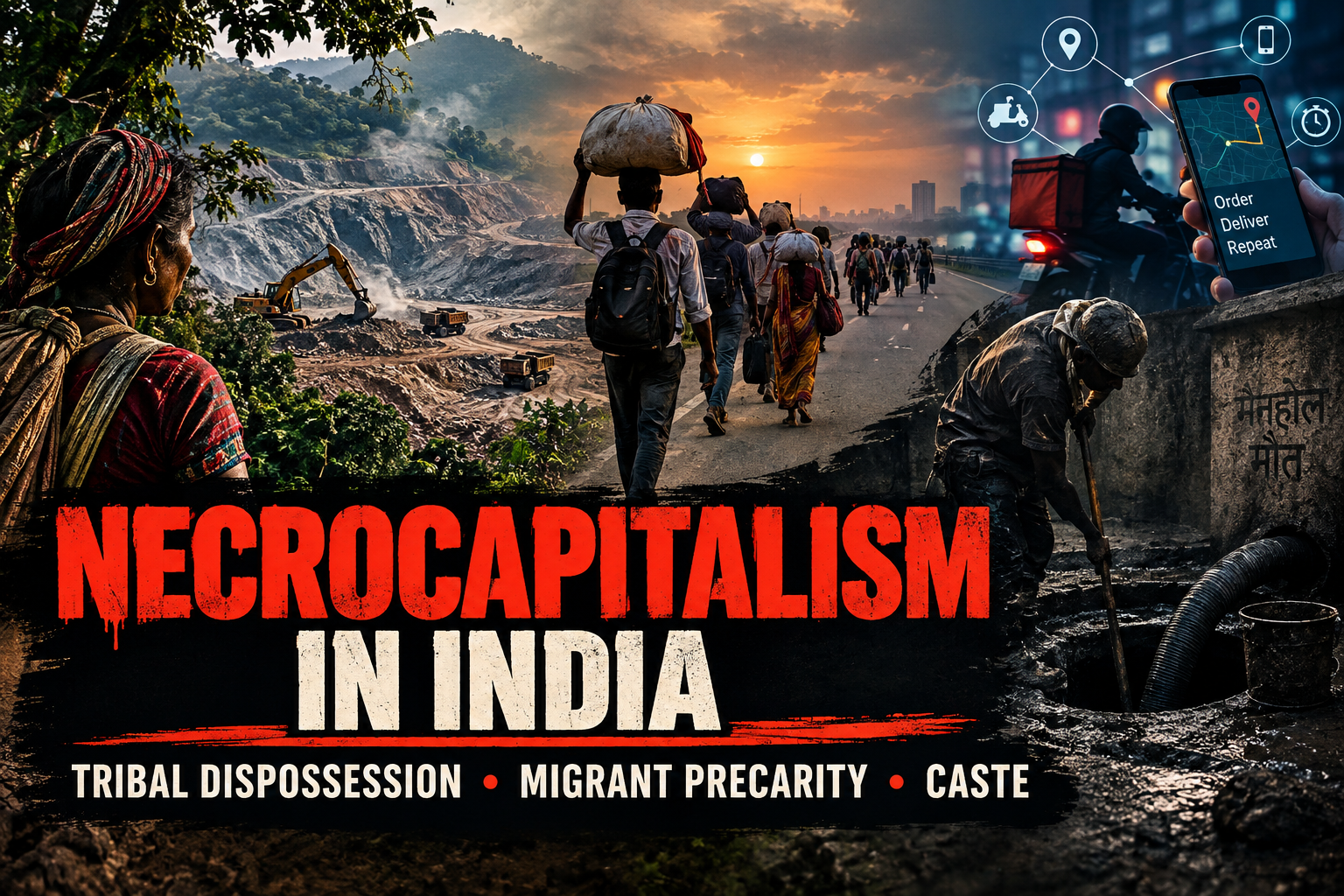
This analysis examines four interconnected domains through which necrocapitalist dynamics operate: tribal dispossession resulting from extractive capitalism, the COVID-19 migrant crisis, caste-based labor regimes, and the gig economy’s facilitation of “slow death.”
I. Tribal Dispossession and Extractivism
India’s mineral-rich forest belt stretches across Odisha, Chhattisgarh, Jharkhand, and parts of Andhra Pradesh, with vast reserves of bauxite, iron ore, and coal beneath its soil. Yet, these lands are also home to some of the country’s most marginalized Adivasi communities. Their coexistence is not a coincidence, but a defining feature of the necrocapitalist logic this analysis traces.
The Vedanta Resources saga in Niyamgiri, Odisha, vividly illustrates this pattern. For the Dongria Kondh tribe, the Niyamgiri hills are sacred lifelines, yet they were threatened with displacement for a bauxite mining venture. In 2013, after village councils voiced their opposition, the Supreme Court paused the project. Still, this episode reveals a troubling norm: tribal lives and traditions are routinely weighed against mineral profits, with the state often siding with extraction unless confronted by powerful resistance or legal intervention.
This pattern is evident throughout the “Red Corridor,” where Naxalite/Maoist insurgency has emerged in direct response to prolonged dispossession. The state’s approach has predominantly been securitized rather than redistributive, involving paramilitary operations such as Operation Green Hunt, the labeling of resistance as “anti-national” or indicative of “Maoist sympathy,” and the criminalization of Adivasi land defenders.
Necrocapitalism thrives on this dual process: extraction advances by making Adivasi lives and claims disappear, labeling their forests as “wasteland” to erase ancestral ties, or casting resistance as a threat to national security. As a result, suffering and deaths caused by displacement, hunger, lost livelihoods, or state violence are quietly absorbed as the hidden costs of economic progress.
The Forest Rights Act (2006) was intended to address these issues by recognizing individual and community forest rights. However, implementation has remained persistently inadequate. The 2019 Supreme Court order (later stayed), which threatened the eviction of over a million tribal families whose FRA claims were rejected—often due to administrative shortcomings rather than invalid claims—demonstrates how legal frameworks can function as instruments of necrocapitalist exposure rather than protection.
II. The COVID-19 Migrant Crisis as a Flashpoint
If tribal dispossession reveals the slow-burning violence of necrocapitalism, the 2020 migrant crisis exposed its most immediate and visible form in modern India.
When India announced a nationwide lockdown on March 24, 2020, with just four hours’ warning, it triggered the largest internal migration since Partition. Suddenly, tens of millions of migrant workers—builders, domestic helpers, factory hands—were abandoned in cities that had depended on their labor, left without wages, shelter, transport, or food, and with no safety net to catch them.
With buses and trains halted, hundreds of thousands set out on foot, trekking hundreds of kilometers back to their villages. Along the way, exhaustion, hunger, heatstroke, and road accidents claimed many lives—including the haunting tragedy near Aurangabad, where a train ran over migrants sleeping on the tracks.
The necrocapitalist reading emphasizes several features:
The longstanding invisibility of migrant labor is significant. India’s migrant workforce, estimated at over 100 million internal migrants, has historically existed outside comprehensive data collection and policy frameworks. The absence of a reliable national registry for migrant workers indicates that the state has facilitated decades of urban growth without tracking, housing, or planning for this population. Such structural invisibility is emblematic of necrocapitalism, in which essential labor is performed by populations whose lives remain administratively unrecognized.
The lockdown laid bare a logic of disposability: policies focused on containing the virus and safeguarding those with wealth, property, and influence—the ones who could afford to stay home. Meanwhile, the hardships of containment fell squarely on those without such privilege. Migrant workers became the shock absorbers of policy, their suffering and deaths treated as unfortunate but acceptable side effects, not central concerns.
The government’s eventual rollout of “Shramik Special” trains in May 2020 came weeks late and, at first, required workers or state governments to pay fares—sparking confusion and further delays. This lag between crisis and response reveals a necrocapitalist pattern: mass suffering is addressed only when it erupts into public outrage, not as a matter of urgent responsibility.
The crisis also exposed a bitter irony: workers labeled “essential” for the economy are not considered essential enough to deserve protection when the system falters.
III. Caste Capitalism: The Racial/Caste Intersection
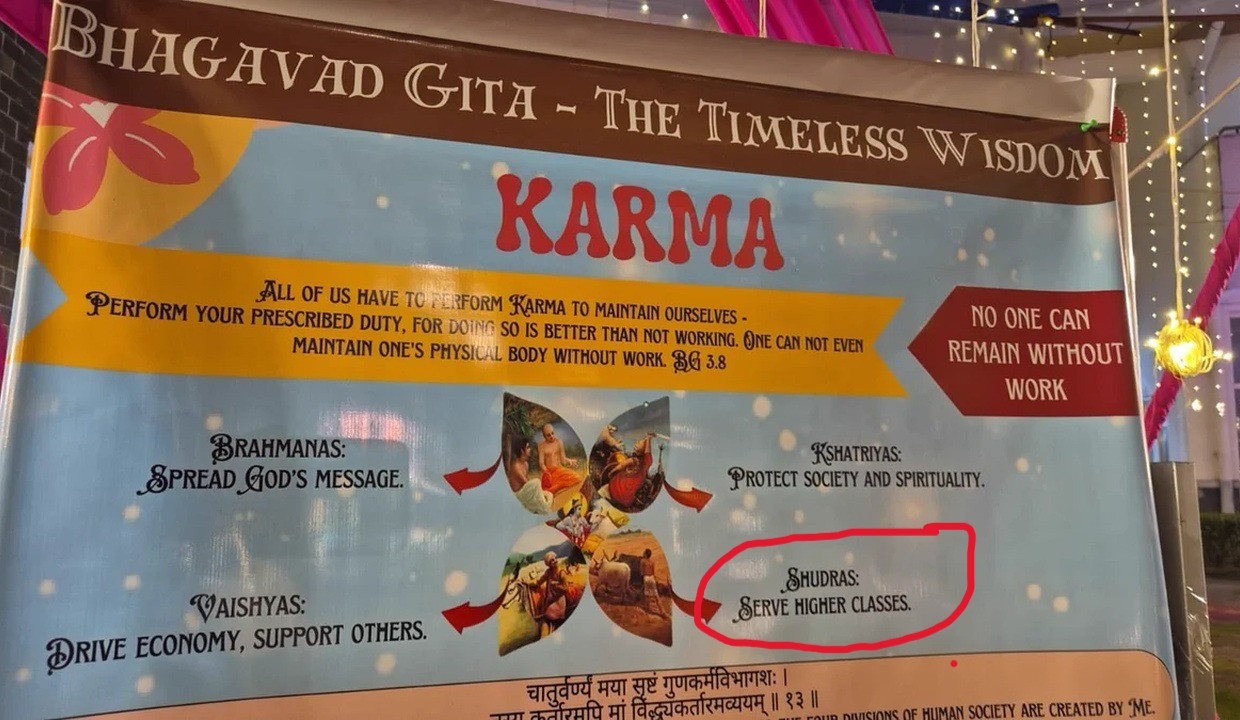
A comprehensive theorization of necrocapitalism in India necessitates foregrounding caste, which operates in structurally analogous ways to race in other necropolitical contexts. Scholars such as Gopal Guru, Kancha Ilaiah Shepherd, and Suraj Yengde have articulated this comparison through frameworks such as “caste capitalism” or “Brahmanical capitalism.”
Caste consistently determines who undertakes India’s most hazardous and stigmatized forms of labor. Manual scavenging—the cleaning of human excreta from dry latrines and sewers—remains predominantly performed by Dalits, particularly those from the Valmiki community, despite legal prohibitions enacted in 1993 and reinforced in 2013. Fatalities from asphyxiation during septic tank and sewer cleaning are regularly reported; data from organizations such as the Safai Karmachari Andolan indicate hundreds of such deaths in the past decade, with employer convictions remaining exceedingly rare. This represents necrocapitalism in its most explicit form: caste assigns specific groups to labor with inherent risks of death, and the economic system internalizes these fatalities as routine operational costs.
Caste continues to shape who owns land, capital, and secure jobs, locking Dalits and Adivasis into the most dangerous and poorly paid work—brick kilns, quarries, sanitation, leather, and farm labor—while keeping them out of positions of power, even with constitutional safeguards. The COVID-19 migrant crisis made this painfully clear: most stranded migrants were Dalit or Adivasi, showing that necrocapitalist vulnerability during the lockdown was driven as much by caste as by class.
B.R. Ambedkar’s idea of “graded inequality” sheds light here: caste does not simply split society into oppressors and oppressed, but creates a ladder of disposability. Risk and dignity are rationed out unevenly, and those at the bottom are treated as expendable—even by others who are themselves marginalized.
IV. The Gig Economy and “Slow Death” Labor
If the migrant crisis was a sudden rupture, the gig economy is necrocapitalism on slow drip—what Lauren Berlant calls “slow death”: bodies worn down not by disaster, but by relentless, everyday precarity.
India’s platform economy—Swiggy, Zomato, Ola, Uber, Urban Company, Amazon, Zepto, and more—has exploded, drawing in millions who are labeled as “partners” rather than employees. This label is crucial: it strips workers of basic protections such as the minimum wage, health insurance, accident cover, and limits on working hours. Meanwhile, algorithms quietly dictate their routes, schedules, ratings, and pay, all hidden behind complex incentive systems.
Several dynamics compound this precarity:
Algorithmic discipline and relentless time pressure define gig work. Delivery workers are pushed to race against the clock, especially under 10-minute delivery promises. This pressure fuels risky driving through traffic, scorching heat, and monsoon rains. Heatstroke, accidents, and chronic injuries are common, but these dangers rarely make it into official records or compensation schemes.
The absence of social security remains a critical issue. Although the Code on Social Security (2020) nominally extended certain protections to gig workers, implementation has been slow. Most platform workers continue to lack employer-provided health insurance, accident coverage, or retirement benefits, resulting in medical emergencies frequently leading to debt spirals, and algorithm-driven ratings and sudden deactivations make incomes even more precarious. Workers can lose their livelihoods overnight, with little chance to appeal, turning insecurity into a permanent condition rather than a passing setback. Unlike the sudden, visible deaths of the migrant crisis, gig work quietly erodes health over time. Chronic illness, constant strain, stress, and shortened lives become the norm for workers without safety nets. This is Berlant’s “slow death” in action: a creeping, widespread decline that rarely sparks alarm, even though its cumulative toll may surpass that of headline-grabbing disasters.
Labor organizing—such as the efforts of the Indian Federation of App-based Transport Workers—has won small victories, including Rajasthan’s 2023 Gig Workers Act. Yet, across India, the basic pattern remains: platforms shift risks onto individual workers, leaving them to bear the brunt alone.
Conclusion: Development as Necropolitics
A clear pattern runs through all four cases: since liberalization, Indian capitalism has banked on exposing certain groups—tribals, migrants, Dalits, gig workers—to early death, loss, or slow decline. This is not just neglect, but a deliberate logic that treats some lives as expendable for profit, growth, or urban comfort. State protections arrive unevenly, usually only when public outrage makes inaction impossible.
It is important to recognize that “necrocapitalism” functions as an analytical and critical framework, rather than as a universally accepted or neutral descriptor within economic or policy scholarship. Proponents of India’s development trajectory contend that extractive industries, migration-driven urbanization, and gig work have contributed to income growth, poverty reduction, and the creation of voluntarily chosen opportunities—outcomes that a strictly necropolitical perspective may underrepresent. Thus, the necrocapitalist framework is most valuable as a diagnostic tool, prompting critical inquiry into any narrative of economic growth by raising, as Achille Mbembe does regarding sovereign power, the question of who is enabled to live and who is permitted—or compelled—to die.