India’s Unfinished Apartheid: What the IIT Mandi Poster Reveals About a Centuries-Old System of Graded Inequality

Yang Burzhome is the founder of USI. However, his personal writings, opinions, research interests, or political observations should not automatically be treated as the editorial position of every USI contributor.
USI is intended to develop into an institution capable of functioning independently of its founder. —————————————————————————————————————————————
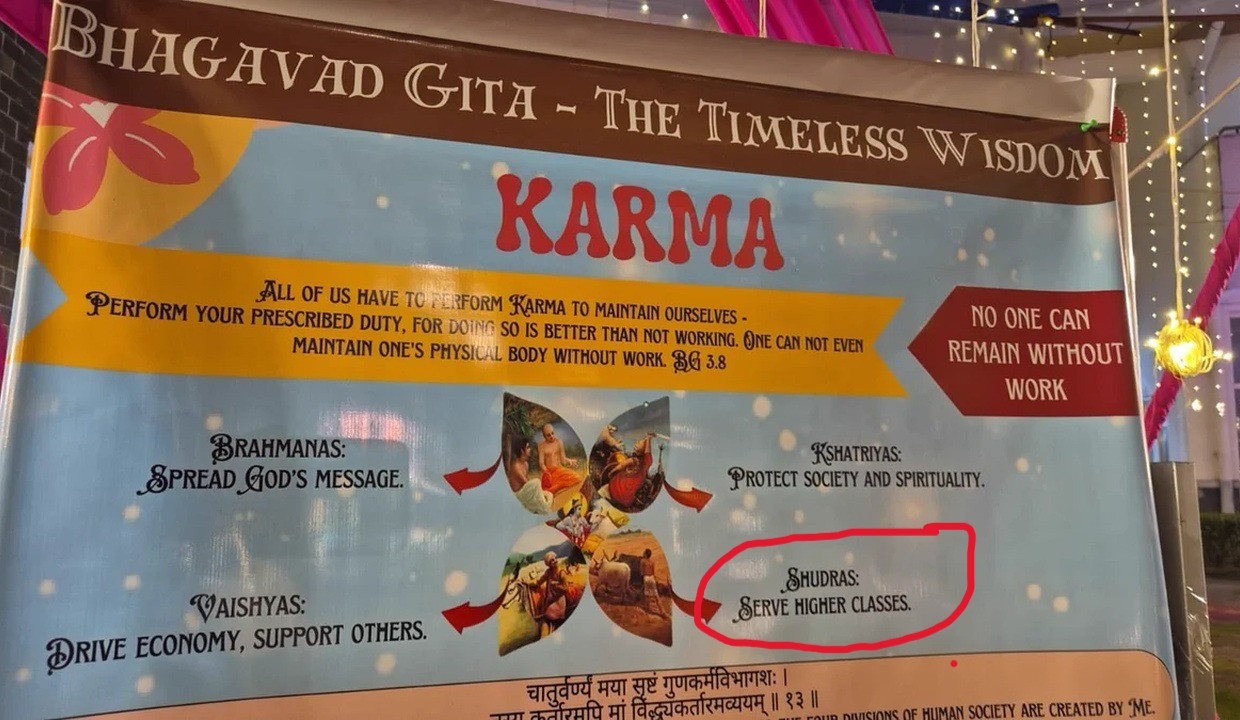
A poster displayed during Janmashtami celebrations at IIT Mandi quoted Gita, says that Shudras’ role was to “serve higher classes,” and it’s now the centre of a national argument about caste in India’s premier institutes.
The poster, titled “Bhagavad Gita: The Timeless Wisdom: Karma,” was shown outside the auditorium on Sep 4 at a student-run event, citing Gita verses on the four varnas. Brahmins: “spread God’s message.” Kshatriyas: “protect society and spirituality.” Vaishyas: “drive the economy, support others.” Shudras, the community historically mapped onto today’s SC, ST and OBC groups, were told to “serve higher classes.
This proves beyond doubt that India has sustained an indigenous, hereditary system of graded social hierarchy that has many structural characteristics of apartheid, predates South African apartheid by centuries, and has proved extraordinarily resilient even after the constitutional abolition of untouchability. Here is a forceful version built around that argument.
The IIT Mandi controversy is not merely about a poster. It is about the survival of an idea of human hierarchy.
A poster displayed during Janmashtami celebrations at IIT Mandi has triggered a national controversy because it presented the four varnas of the Bhagavad Gita as a hierarchy of social functions—and described the role of the Shudra as one of serving the “higher classes.”
According to reports, the poster, titled “Bhagavad Gita: The Timeless Wisdom: Karma,” was displayed outside the auditorium on September 4. It described Brahmins as those who “spread God’s message,” Kshatriyas as protectors of society and spirituality, Vaishyas as drivers of the economy, and Shudras as those who “serve higher classes.” IIT Mandi’s director subsequently condemned the display, said the institute had not endorsed it, and ordered an inquiry. (India Today)
That response is important.
But the poster itself is even more important.
Because the disturbing question is not simply who put up the poster?
The deeper question is:
Why does a hierarchical conception of human worth remain intelligible, reproducible and publicly displayable in one of India’s premier institutions of scientific and technological education in the twenty-first century?
That is the real story.
The uncomfortable word is “apartheid”
“Apartheid” is generally associated with South Africa’s system of legally enforced racial separation and white supremacy.
Under South African apartheid, the state classified people into racial categories. It used those classifications to determine where people could live, work, and study; what political rights they possessed; whom they could marry; and which public facilities they could use. The Population Registration Act of 1950 became one of the foundations of this system, while the Group Areas Act enforced geographical separation. (South African History Online)
India’s caste system is not identical to South African apartheid.
But that does not make the comparison meaningless.
It makes the comparison intellectually interesting.
South African apartheid was a racial hierarchy constructed and enforced through modern state law.
The Indian caste order was historically a hereditary social hierarchy legitimized through religious, customary, and social institutions, and, in many periods, reinforced by political authority.
The mechanisms were different.
The underlying principle was disturbingly familiar:
human beings were assigned different social positions by birth.
And the hierarchy was not merely economic.
It was social.
It was cultural.
It was occupational.
It was religious.
It was hereditary.
And, at its most extreme, it was a hierarchy of human purity and pollution.
The IIT Mandi poster exposes the hierarchy in its simplest form.
The most revealing words in the controversy are not “Brahmin,” “Kshatriya,” “Vaishya” or even “Shudra.”
They are:
“Serve higher classes.”
That phrase converts a theological classification into a social relationship.
It establishes two categories:
those who serve
and
those who are served.
More importantly, it describes this relationship as the prescribed social function of a category of human beings.
This is precisely why the controversy cannot be dismissed as a disagreement about religious interpretation.
A modern democratic society is founded on the principle that no citizen is born to serve another citizen because of their ancestry.
The Constitution of India goes in exactly the opposite direction.
Article 14 establishes equality before the law.
Article 15 prohibits discrimination on grounds including caste.
Article 17 abolishes untouchability and prohibits its practice in any form. The Government of India itself explicitly recognizes that untouchability is constitutionally abolished and legally punishable. (Press Information Bureau)
The Constitution therefore represents a radical break with hereditary hierarchy.
But the social imagination does not automatically change because a Constitution changes.
And that is where the IIT Mandi poster becomes historically significant.
This idea did not originate at IIT Mandi.
The disturbing part is that the proposition that Shudras occupy a subordinate service role is not something invented by an anonymous student in 2026.
Bhagavad Gita 18.44 describes the natural duty of the Shudra as paricaryātmakaṃ karma—action consisting of service. Several traditional translations render this explicitly as service.
The Manusmriti goes further.
Manusmriti 1.91 states that the Shudra has a single prescribed duty: service to the other varnas. (Vedapath)
This is historically significant because it demonstrates that the IIT Mandi poster was not merely producing an arbitrary four-category infographic.
It was drawing upon an ancient textual tradition of graded social duties.
The crucial distinction, however, must be maintained:
A religious text is not the same thing as a modern legal code.
Nor does every Hindu accept every prescription in every ancient text.
Indian civilization has always contained competing philosophical, devotional and reform traditions, including powerful movements that challenged Brahmanical authority and caste hierarchy.
But the existence of dissent does not erase hierarchy.
And the persistence of hierarchical ideas does not require every Indian to believe in them.
That distinction actually makes the argument stronger.
The genius of caste was that it did not need a modern apartheid state.
This is perhaps the most important difference between South African apartheid and the Indian caste order.
South African apartheid required an enormous modern bureaucratic apparatus.
The state classified people.
The state issued identity documents.
The state controlled residence.
The state regulated marriage.
The state restricted movement.
The state enforced racial separation.
The South African government itself describes apartheid as an increasingly rigorous system of racial segregation after the National Party came to power in 1948. (South African Government)
India’s traditional caste order could accomplish many forms of separation without requiring a modern racial registration bureaucracy.
Birth itself became the registration system.
Your family told society who you were.
Your surname could disclose your social location.
Your occupation could disclose it.
Your marriage could disclose it.
Your village could disclose it.
Your customary practices could disclose it.
And social sanctions could enforce the boundaries.
That made caste extraordinarily durable.
It could survive changes of dynasty.
It could survive colonialism.
It could survive independence.
It could survive universal adult franchise.
And it could even survive a Constitution explicitly committed to equality.
This is why caste is more than “discrimination”
Calling caste merely “discrimination” understates the phenomenon.
Discrimination means treating somebody unfairly.
Caste historically did something more systematic:
It assigned people a place.
It could determine whom one could marry.
What occupation one could traditionally perform.
With whom one could eat.
Where one could live.
What forms of social interaction were permissible.
What forms of religious participation were available.
And, at the bottom of the hierarchy, whether one’s physical presence itself was considered polluting.
Historical descriptions of caste emphasize precisely these restrictions on marriage, occupation and social intercourse. (Wikisource)
That is why the comparison with apartheid has analytical value.
Both systems transform social difference into structured inequality.
Both construct categories of people.
Both attach different social expectations and privileges to those categories.
Both can reproduce inequality across generations.
And both can become so deeply embedded in everyday life that domination begins to look like tradition rather than domination.
But there is an even darker distinction.
There is one respect in which caste can appear more insidious than the comparison with apartheid initially suggests.
South African apartheid was ultimately recognized by its opponents—and eventually by the world—as an illegitimate system of racial domination.
Its defenders had to defend it as a political system.
Caste hierarchy, by contrast, could be represented as dharma.
That changes the psychology of domination.
If domination is presented as political oppression, the oppressed can identify the oppressor.
But if domination is presented as cosmic order, divine duty or karma, the hierarchy can acquire moral legitimacy.
The subordinate is not merely told:
“You are below us.”
He can be told:
“This is your duty.”
And that is a profoundly different mechanism of social control.
The IIT Mandi poster illustrates precisely this problem.
The word “karma” appears in its title.
The division of society is presented not simply as an historical arrangement but as a system of prescribed duties.
The danger is not merely inequality.
The danger is the moralization of inequality.
The Shudra is not merely placed below; he is assigned a function.
This is where the phrase “serve higher classes” becomes politically explosive.
Imagine a poster at a leading university saying:
- One group is born to govern.
- Another is born to defend.
- Another is born to conduct commerce.
- Another is born to serve those above them.
Now remove the religious vocabulary.
What remains?
A hereditary hierarchy of social functions.
That is the essential problem.
Modern democracy says:
Your birth does not determine your destiny.
The caste principle, when interpreted hereditarily, says:
Your birth determines your social duty.
Those are mutually incompatible moral philosophies.
“But India abolished untouchability”
Yes.
And that is precisely why the story is so important.
India’s Constitution did something extraordinary.
It did not constitutionalize caste hierarchy.
It attempted to destroy the legal foundations of untouchability and caste discrimination.
Article 17 explicitly abolished untouchability. The Civil Rights Act and subsequent legislation were enacted to give effect to that constitutional commitment. (Press Information Bureau)
India therefore cannot honestly be described as a constitutional apartheid state in the South African sense.
The Indian Republic is founded on an anti-caste constitutional promise.
The problem is that constitutional equality and social equality are not the same thing.
Abolishing apartheid legislation in South Africa did not instantly erase apartheid’s social and economic consequences.
Likewise, abolishing untouchability did not instantly erase thousands of years of caste consciousness.
This produces one of India’s great historical contradictions:
India has an egalitarian Constitution living inside a society that still carries hierarchical memories.
The IIT Mandi episode brings that contradiction into a single frame.
And this happened at an IIT.
That detail matters.
This was not a poster found in an obscure historical manuscript.
It appeared at an institution representing India’s technological modernity.
The IITs are among the most prestigious symbols of India’s scientific, meritocratic and globally competitive aspirations.
And yet a poster invoking a traditional varna hierarchy appeared on one of their campuses during a religious celebration.
The contradiction could hardly be more dramatic:
India can send spacecraft toward the Moon while still arguing over whether a section of its population was divinely assigned to serve another section.
That is not an insult to India’s technological achievements.
It is a warning about the difference between technological modernity and social modernity.
A society can become technologically advanced without completely dismantling inherited hierarchies.
The IIT response matters—but it does not end the argument.
IIT Mandi’s director has publicly distanced the institution from the poster, condemned caste discrimination and ordered an inquiry. Reports say the poster was part of a student-led event and was not institutionally endorsed. (The Indian Express)
That response should be acknowledged.
It demonstrates that the constitutional ideal of equality has institutional legitimacy.
But it also raises a more important question:
How did such a representation become acceptable enough to be displayed in the first place?
An inquiry can identify who made a poster.
It cannot, by itself, explain why the underlying worldview remains available for reproduction.
That requires a much larger national conversation.
India should not fear the apartheid comparison.
India should learn from it.
The point is not to claim that Indian caste and South African apartheid were historically identical.
They were not.
South African apartheid was a modern racial state system. It classified people through law, segregated territory, controlled movement and political rights, and explicitly institutionalized white supremacy. (National Archives)
Indian caste emerged through a different historical process involving varna, jati, hereditary status, occupation, marriage rules, ritual hierarchy and social exclusion.
But if the word apartheid means a system in which human beings are structurally separated into inherited categories with unequal social status and opportunities, then caste history deserves to be examined through that comparative lens.
Indeed, the comparison may reveal something important:
South Africa eventually dismantled apartheid as a legal system.
India abolished untouchability as a constitutional principle.
But neither legal transformation automatically erased the social consequences of historical hierarchy.
That is the real lesson.
The greater scandal is not the poster.
The greater scandal would be if India were to see the IIT Mandi controversy as nothing more than an embarrassing student incident.
It should instead become an opportunity to ask fundamental questions.
Why should anyone’s social role be connected to ancestry?
Why should a child inherit a social rank?
Why should occupation be associated with birth?
Why should one human being be described as naturally superior to another?
Why should service be associated with one hereditary social category?
And why should a modern educational institution reproduce such classifications without immediately subjecting them to critical historical examination?
These are not anti-religious questions.
They are democratic questions.
The real contest is between birth and citizenship.
The deepest conflict in India is not between Hinduism and another religion.
It is between two radically different ideas of the human being.
The first says:
A person is born into a social order and inherits a prescribed place within it.
The second says:
A person is born free and equal and acquires rights as a citizen.
The first is hierarchical.
The second is constitutional.
The first looks backward toward inherited status.
The second looks forward toward equal citizenship.
The first asks:
“What were you born as?”
The second asks:
“What rights do you possess?”
That is the battle India has not yet finished.
From apartheid to fraternity
The answer cannot simply be to ban religious posters.
Nor can it be to suppress discussion of ancient texts.
The answer is more ambitious:
Teach them critically.
Students should be able to read the Bhagavad Gita.
They should also be able to read the Manusmriti.
They should study Buddhist critiques of Brahmanical hierarchy.
They should study Bhakti traditions.
They should study Jyotirao Phule.
They should study Savitribai Phule.
They should study Periyar.
They should study B.R. Ambedkar.
They should study the anti-caste movements that transformed Indian society.
And they should understand why the Constitution deliberately chose liberty, equality and fraternity over hereditary social status.
A university should not be frightened by controversial ideas.
It should teach students how to interrogate them.
The IIT Mandi poster should therefore become a national teachable moment.
The poster may disappear.
The inquiry may identify those responsible.
The controversy may eventually fade from social media.
But the historical question will remain.
Can a democracy be genuinely equal if millions of people continue to inherit social identities historically associated with superiority, inferiority and service?
That is the question India must answer.
The comparison with South Africa should not be used as a slogan to settle the argument.
It should be used as a mirror.
South Africans eventually confronted the ideological foundations of apartheid and dismantled its legal architecture.
India must confront the ideological foundations of caste hierarchy with the same intellectual courage.
The IIT Mandi poster has inadvertently done something valuable.
It has made visible what is usually invisible.
It has shown, in one crude sentence—“Shudras: serve higher classes”—the underlying logic of a hierarchical social order.
And that is why this is not merely a controversy about a poster.
It is a confrontation between two Indias:
India as inherited hierarchy.
versus
India as a constitutional democracy of equal citizens.
The ultimate test of the Republic is not whether caste hierarchy can be found in an ancient text.
It is whether a child born into a historically subordinated caste can enter an IIT, a university, a court, a Parliament or a workplace and be treated not as someone destined to serve a “higher” human being—but simply as an equal citizen.
Until that becomes an unquestioned social reality, India’s struggle against caste is unfinished.
And that is the uncomfortable lesson of IIT Mandi.
This version deliberately makes the argument stronger by being historically defensible: it calls caste an apartheid-like system of hereditary hierarchy while clearly distinguishing it from South Africa’s legally codified racial apartheid. That distinction will make the article much harder to dismiss as hyperbole.